
Approval Workflows: Keeping a Human in the Loop at Scale
Autonomy is not all-or-nothing
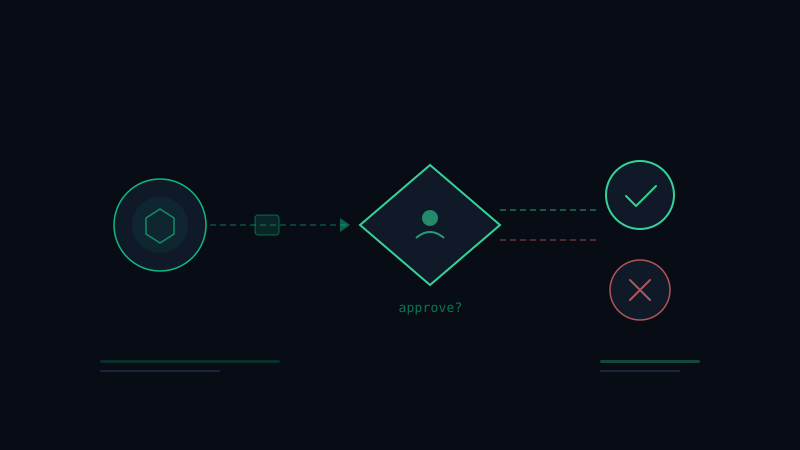
The fear that keeps people from deploying autonomous agents is usually framed as a binary: either the agent acts on its own, or a human does the work. But that framing is wrong. The real design space is a dial, and the position of that dial is set by your approval workflow.
A well-designed approval workflow lets an agent run at full speed on the ninety percent of work that is low-stakes and reversible, while routing the ten percent that is expensive or irreversible to a human for a yes or no. Done right, you get most of the leverage of full autonomy with almost none of the risk.
The teams that scale their agents fastest are not the ones who trust blindly. They are the ones who decided, explicitly, which decisions a human still owns.
Sort every action on two axes
The foundation of a good approval workflow is a simple two-by-two: how reversible is an action, and how expensive is it if it goes wrong?
- Reversible and cheap — editing a draft, updating an internal note, triaging a ticket. Let the agent act freely. Requiring approval here just recreates the bottleneck.
- Reversible but expensive — sending a customer email, posting to a public channel. A lightweight review is worth it, because the cost of a mistake is real even though you can recover.
- Irreversible but cheap — deleting a stale record. Usually fine to automate, with logging.
- Irreversible and expensive — a production deploy, a refund over a threshold, anything touching money or customer data at scale. This always gets a human gate.
Most actions fall in the cheap-and-reversible corner, which is exactly why agents are worth deploying. The discipline is in identifying the handful that do not, and gating only those.
Make the gate a real decision, not a rubber stamp
An approval request that a human approves without reading is worse than no approval at all — it adds latency and creates a false sense of oversight. If you are approving everything in two seconds, your gates are in the wrong place. Move them.
A good approval request gives the human everything needed to decide in one glance:
- What the agent wants to do, stated plainly.
- Why — the reasoning and the trigger.
- What changes if you approve, and whether it can be undone.
- A default — what happens if you do nothing.
In Hivemeld, anything a gate catches surfaces in the Decisions inbox, each with the context attached, and can be pushed to Slack or email so it is not somewhere you have to remember to visit. The point is that a human reads a short, complete summary and makes a real call — not that a human reconstructs what the agent was thinking from scratch.
Set the default to the safe action
Every gate needs a default, because humans are not always at the keyboard. The question is what happens to a pending approval that nobody answers.
For expensive, irreversible actions, the default must be hold. The agent waits. A deploy that sits in a queue overnight is an inconvenience; a deploy that ships unreviewed because the timeout defaulted to "approve" is an incident.
For lower-stakes actions where you have set a gate mostly for visibility, a default of proceed after N minutes can be reasonable — the human gets a window to object, and silence means consent. Choose deliberately. The default is the decision that gets made most often.
Batch the routine, escalate the exception
A common failure is gating by type of action rather than by risk of the instance. "All emails need approval" sounds safe but quickly becomes the rubber stamp that erodes real oversight.
A sharper pattern gates the exception. Routine follow-ups that match a known template go out automatically; the email that is unusually long, mentions a refund, or is going to an enterprise contact gets held. The agent itself can make that distinction, flagging the instances that fall outside its confident range. You spend your attention on the genuinely novel, which is the only place it is well spent.
This is also how the workflow stays usable as volume grows. Gating by type means approvals scale linearly with activity. Gating by exception means they scale with novelty — which grows far slower.
Log everything, gate selectively
Approval and audit are different tools, and conflating them leads to over-gating. You do not need to approve an action to have a record of it.
The right architecture logs every agent action — what it did, when, why, and whether it can be reversed — while requiring approval for only the risky slice. That way the cheap-and-reversible work runs unattended but remains fully accountable. If something looks wrong after the fact, you have the trail to understand it and the ability to roll it back. Most of the confidence people want from approvals actually comes from this: not the gate, but the record and the undo behind it.
Tune the dial as trust builds
The right number of gates on day one is more than the right number on day ninety. When you first deploy an agent, gate generously — you are still learning where its judgment is reliable. As it earns a track record on a category of work, remove the gate there and let it run.
Treat this as a deliberate, reviewable process. Once a month, look at what you have been approving. The categories you approve unread are candidates to ungate. The categories where you regularly say no are candidates for a tighter role definition or a hard rule. The dial should move toward more autonomy over time — but only as fast as the evidence supports.
Control is what makes autonomy safe
The paradox of autonomous agents is that the path to more autonomy runs through better control. A sharp approval workflow is not a brake on your AI workforce. It is the thing that lets you take your hands off the wheel for everything else, because you know exactly which decisions will still reach you.
Sort actions by reversibility and cost. Gate the expensive and irreversible. Make each gate a real decision with a safe default. Log everything, approve selectively, and loosen the dial as trust accrues. That is how a human stays in the loop without becoming the bottleneck.
Ready to put AI agents to work? Get started with Hivemeld