
AI Agent Communication: How Agents Report, Escalate, and Hand Off
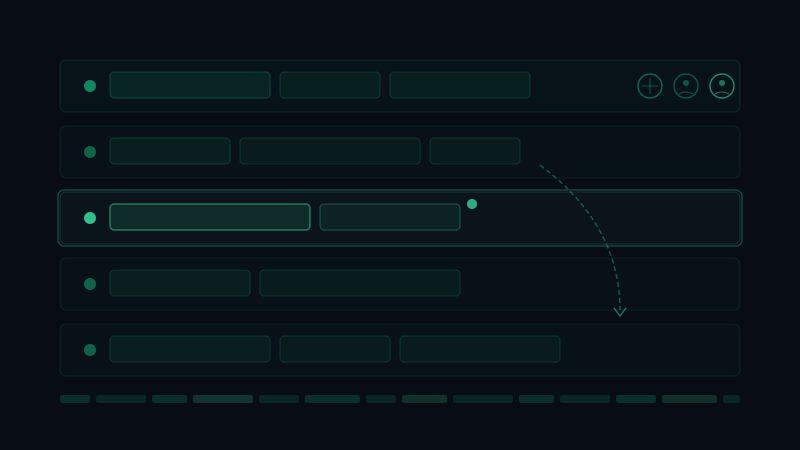
Opacity is the failure mode
AI agent communication is not a secondary concern. It is the primary trust mechanism between your AI workforce and the humans accountable for what it does.
An agent that does good work in silence is almost indistinguishable from one that does nothing — or worse, one that does something wrong without anyone noticing. The communication layer is what makes agent behavior visible, auditable, and correctable. Without it, you do not have an AI workforce. You have a black box.
This post covers how Hivemeld handles it: what agents record, how they escalate, how they hand off to each other, and why the answer is a Decisions inbox and an action log rather than a chat channel.
The three problems to solve
1. How do I know what the agent did?
Agents need to produce structured, readable records. Not log files, not raw JSON. Entries that say what was done, what it was based on, and what — if anything — needs a person.
The difference between "Task completed" and a record covering the action taken, the evidence behind it, the prior state, and the agent responsible is the difference between an agent you trust and one you tolerate.
2. How does the agent know when to involve a human?
Escalation is the harder design problem. Too sensitive and the agent interrupts constantly, which is the opposite of the autonomy you wanted. Not sensitive enough and it makes decisions it should not make alone.
Vague escalation rules produce both failures at once. "Use good judgment" is not a policy. Hivemeld's answer is four explicit conditions, which we come back to below.
3. How do agents hand off to each other?
A single agent accomplishes a defined scope. A team accomplishes more because agents pass context, coordinate on shared work, and route things to the right domain. That needs a shared record where handoffs are visible to humans as well as to the receiving agent.
Why not a chat channel
Early versions of Hivemeld used Discord as the communication layer, and the reasoning was decent: channels map to departments, and oversight in a room you already sit in costs nothing extra. Transparency that requires a special trip to a special dashboard does not happen.
What that design got wrong was the shape of the information. Agent output is not conversation. A channel is a stream, and a stream has three problems once agents are acting rather than reporting:
It mixes the two kinds of message. A decision that needs an answer and a record of something already done look identical in a feed, scroll past at the same speed, and get skimmed at the same rate. The thing that needed a person gets lost among the things that did not.
It has no state. A question in a channel is answered, ignored, or forgotten, and nothing distinguishes those outcomes. There is no such thing as an open item.
It is not queryable. "Why did this close date move in June" is a search through months of prose, which means in practice nobody asks.
So the layer split in two, by the job each part does.
The Decisions inbox
Everything that needs a person lands in one list: the question, which agent is asking, the context behind it, and a place for your answer. Resolve it with a decision, or dismiss it. Either way the agent carries on, and the item leaves the list.
What reaches that list is governed by four conditions, not by an agent's sense of its own importance:
- Spend over a limit you set.
- A new kind of action the agent has not been cleared for. Clearing it is a one-time category decision, not a per-instance approval, so the list does not regrow.
- Low confidence in the agent's own read of the evidence.
- Flagged accounts — the customers, deals, or people nothing touches unattended.
The ratio is the whole design. A list that contains only these four kinds of thing is short enough to read carefully. A list that contains everything the agents did trains you to clear it without reading, which is worse than no oversight at all because it looks like oversight.
The action log
Everything agents do without asking is recorded: what changed, the prior value, what triggered it, what evidence supported it, which agent did it, and whether a human was involved.
This is where visibility actually lives. Six months from now, when someone asks why a close date moved or who authorised a vendor renewal, the answer is a query rather than an archaeology project. It exports, it searches, and it is the thing an auditor reads.
The division of labour between the two surfaces is worth stating directly. The Decisions inbox is for the future: things that have not happened yet and need a call. The action log is for the past: things that happened and should be explicable. Conflating them is how both jobs get done badly.
Agent-to-agent handoffs
Inter-agent communication runs through structured handoff records rather than direct programmatic calls.
When the support agent identifies a bug that belongs to engineering, it writes a handoff: the customer-facing summary, the error data it has, and its confidence in the diagnosis. The engineering agent picks that up and acts within its own domain.
Routing through a visible record rather than an API call buys three things:
- Visibility. A human can see what was passed and how the receiver responded.
- Auditability. Every handoff is in the log. That is the trail.
- Interruptibility. If a handoff looks wrong, a person can stop it before the receiving agent acts.
The routing is determined by the escalation rule, not by which end of the handoff is human or AI. A support agent escalating to an engineering agent uses the same mechanism as a support agent escalating to a human engineer.
Report structure matters more than report volume
Every agent record follows a consistent shape. What was done or proposed. What it was based on. What changed. What needs attention, if anything.
That consistency is what makes scanning possible. When you know the format, you can read a day's worth of agent activity in a minute and know whether anything is off. When the format varies, you have to read everything carefully, which defeats the purpose and is why you stop.
Integrations still matter for reach: Hivemeld can push notifications into Slack or email so the Decisions inbox is not somewhere you have to remember to visit. But the notification is a pointer. The record is the system.
What good communication enables
Trust calibration. You develop a clear sense of where each agent performs reliably and where it escalates. You can raise or lower thresholds based on actual behavior rather than speculation — and the log is what tells you which.
Human focus. Your team handles what actually requires judgment. The Decisions inbox becomes a short daily agenda rather than a stream.
Organizational memory. The log is a record of what happened, when, and why. New team members read back through it to understand patterns and decisions. That is institutional knowledge that does not leave when people do.
You can read more about how the workforce is structured in Introducing Hivemeld.
Communication is the product
It is tempting to treat communication as plumbing around the real work. For AI agents it is closer to the opposite. An agent that does useful things but cannot explain what it did, or flag what it needs, is not an asset. It is a liability with good output.
The communication layer is where trust between human and agent is built and recalibrated. Get it right and the rest of the system scales. Get it wrong and you spend your time auditing instead of delegating.
If you want to see what this looks like in practice, start here.
Ready to put AI agents to work? Get started with Hivemeld