
Agent Handoffs: How AI Workflows Chain Without Dropping Context
The handoff problem
Single-agent systems hit a ceiling when the work spans multiple domains. A research task that produces a brief, which becomes a draft, which needs editing, which needs scheduling — that is four distinct competencies. A single agent can attempt all four, but the output quality degrades as the scope expands.
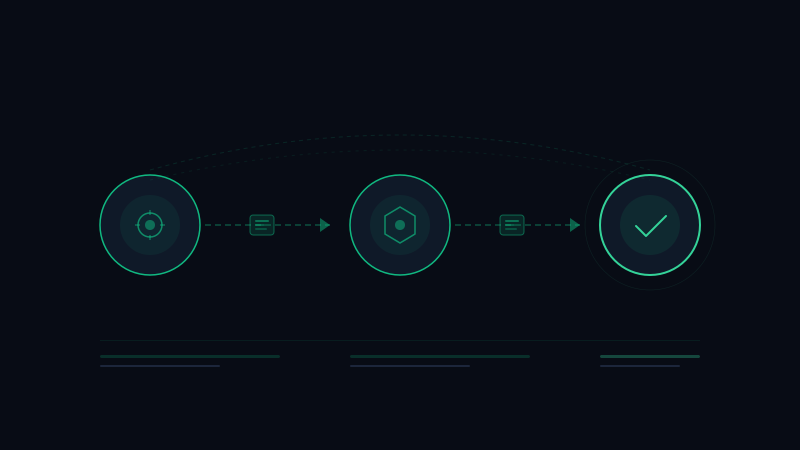
The alternative is specialization: multiple agents, each optimized for one domain, passing work between them. But this introduces a new problem. How does the second agent know what the first agent decided? How does the third agent understand the constraints that shaped earlier decisions?
This is the handoff problem. It is the difference between a relay team that passes the baton cleanly and one that drops it at every exchange.
What a handoff contains
A good agent handoff is not just "here is the output." It is structured context that tells the receiving agent what was done, why it was done that way, what constraints applied, and what the next agent is expected to deliver.
The components of a well-formed handoff:
Deliverable. The actual output of the previous step — a document, a dataset, a decision, a plan.
Rationale. Why the deliverable looks the way it does. What alternatives were considered and rejected. What tradeoffs were made.
Constraints carried forward. Parameters from the original request that still apply — deadlines, tone requirements, audience specifications, budget limits.
Open questions. Anything the previous agent could not resolve that the next agent needs to handle or escalate.
Success criteria. What "done" looks like for the next step, as understood from the overall workflow.
When all five components travel with the work, the receiving agent operates with full context. When any are missing, the receiving agent either guesses or asks — both of which slow the workflow down.
Sequential vs. parallel handoffs
Not all workflows are linear. Some steps can run in parallel, with results converging at a later stage.
Sequential handoffs
Research → Brief → Draft → Edit → Publish. Each step depends on the previous one completing. The handoff is a direct pass from one agent to the next, and the chain only moves as fast as its slowest link.
Sequential handoffs are appropriate when each step fundamentally transforms the work in a way that the next step depends on. You cannot edit a draft that has not been written.
Parallel handoffs
A product launch might need a blog post, a social thread, an email campaign, and an internal announcement — all from the same brief. These can be written simultaneously by different agents, all receiving the same handoff from the strategy agent.
Parallel handoffs increase throughput but require a convergence point: someone or something that reviews all outputs for consistency before they ship.
Conditional handoffs
Some workflows branch based on results. A data analysis agent might hand off to a "write the report" agent if results are routine, or to a "flag for human review" agent if anomalies are detected. The handoff destination depends on what the previous agent found.
Conditional handoffs require the routing logic to be defined in advance. The agent making the decision needs clear criteria for which path to take.
Where handoffs break
Most workflow failures are not agent failures — they are handoff failures. The work was fine. The transfer was not.
Context loss
The most common failure. Agent A produces excellent research. Agent B receives only the summary, not the reasoning. Agent B makes a decision that contradicts something Agent A already considered and rejected — because the rejection rationale was not in the handoff.
Fix: include rationale and rejected alternatives in every handoff. The receiving agent needs to know what was tried, not just what was chosen.
Constraint drift
The original request specified a professional tone for a specific audience. By the third handoff, the tone specification has been dropped because each agent summarized the context a little more aggressively. The final output does not match what was asked for.
Fix: carry constraints as structured metadata that persists unchanged through every handoff, separate from the evolving deliverable.
Scope creep at the boundary
Agent B receives a handoff and interprets its scope more broadly than intended. Instead of editing the draft, it rewrites it. Instead of formatting the data, it re-analyzes it. The boundary between roles becomes unclear.
Fix: success criteria in the handoff should specify what the receiving agent should and should not change. Explicit scope is better than implied scope.
Designing for clean handoffs
If you are building multi-agent workflows, the handoff protocol matters more than the individual agent quality. A team of good agents with bad handoffs produces worse results than a team of adequate agents with excellent handoffs.
Define the handoff schema
Before building the workflow, define what travels between each pair of agents. What fields are required? What format do deliverables take? What metadata persists?
This is not bureaucracy. It is the contract that makes the system reliable.
Test handoffs in isolation
You can test a handoff without running the full workflow. Give Agent B a synthetic handoff and see if it produces the expected output. If it does not, the problem is either the handoff format or Agent B's instructions — and you can fix it without debugging the entire chain.
Monitor the boundaries
When a multi-agent workflow produces bad output, check the handoffs first. Read what was passed between agents. The failure point is almost always at the boundary, not within an agent's execution.
The Hivemeld approach
Hivemeld is designed for multi-agent workflows where agents have distinct roles and pass work between them. The platform handles handoff context automatically — when one agent's output feeds another agent's input, the full context travels with it.
You define the workflow. You define the roles. The platform ensures that the context does not degrade as work moves through the system.
Multi-agent workflows are how real work gets done. See how Hivemeld's agent architecture makes this possible in Introducing Hivemeld — Your AI Workforce.
Ready to build workflows that do not drop context? Start building on Hivemeld.
Ready to put AI agents to work? Get started with Hivemeld