
Putting an AI Agent On-Call: Incident Response Without the Pager
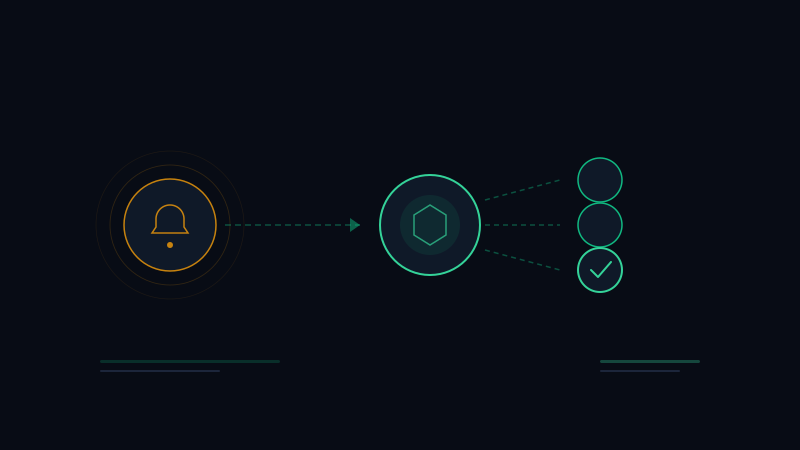
The page that ruins the night
Every operator knows the feeling: the alert fires at 3 a.m., and most of the time it is something routine — a transient error, a disk filling slowly, a third-party blip that resolves itself. You wake up, confirm it is nothing serious, and go back to a sleep that never fully returns. The cost of on-call is not the rare real incident. It is the steady tax of being the one who has to look.
An AI agent on first response changes the economics of that tax. It cannot replace human judgment for the genuinely serious incident — and it should not try. But it can absorb the triage, handle the routine, and make sure that when it does wake you, it is for something that actually warrants it.
First response is triage, not heroics
The job of a first responder is not to fix everything. It is to answer one question fast: is this routine, or is this real? An on-call agent earns its place by answering that question well.
When an alert fires, the agent gathers context a human would otherwise gather groggily — recent deploys, related logs, whether the same alert fired and resolved before, whether dependencies are healthy. It correlates the signal against what it knows. Most alerts, assessed this way, are routine, and the agent can note them, apply a known remediation, and move on without waking anyone.
The point is to compress the slow, expensive human step — figure out what is going on — into something that has already happened by the time a human is involved, if a human needs to be involved at all.
Define the runbook as the agent's role
An on-call agent is only as good as the runbook behind it. The role definition is the runbook, written so the agent knows exactly what it may do on its own and what it must escalate.
A good on-call role specifies the known incident classes and their remediations — restart this service, clear this queue, roll back this deploy — along with the conditions under which the agent is allowed to apply them automatically. It specifies what the agent must never touch without a human: anything affecting customer data, anything irreversible, anything outside the catalogued cases. And it specifies the escalation path: who gets woken, how, and with what context attached.
This is the same discipline good SRE teams already practice. The agent does not invent a runbook; it executes the one you would have followed, instantly and at any hour.
Automate the reversible, escalate the rest
The two-axis rule that governs all agent autonomy applies sharply to incidents. Reversible, well-understood remediations — restarting a stuck worker, clearing a backed-up queue — are exactly what an agent should handle on its own at 3 a.m., because the cost of waiting for a human exceeds the cost of the action.
Anything irreversible or outside the known set escalates immediately. A novel error the agent has not seen, a problem touching billing or customer data, an incident that its first remediation did not resolve — these are precisely the cases where human judgment is worth waking for. The agent's job there is not to act but to prepare: by the time you are awake, the timeline, the logs, and the agent's assessment are already assembled.
The result is that automated actions handle the cases that should never have required a human, and humans handle the cases that genuinely do — with a head start instead of a cold one.
Escalate with context, not just noise
A page that says "error rate high" sends a human into a cold investigation. A page from a well-designed agent says what fired, what the agent already checked, what it tried, what changed recently, and what it believes is going on — with links to the evidence.
That difference is the whole value of the handoff. The human wakes into a briefing, not a mystery. In Hivemeld, the agent posts its assessment to the incident channel and pages through the escalation path with that context attached, so the first thing the on-call human sees is a coherent picture rather than a raw alarm. Time-to-understanding, the slowest part of most incidents, is mostly already spent.
Close the loop and learn
An incident is not over when it is mitigated. It is over when it is understood and the next one is less likely. An on-call agent should write up what happened — timeline, cause, remediation, follow-ups — into your knowledge base automatically, so the postmortem exists without anyone staying up to write it.
Over time this is where the compounding value lives. Each incident the agent handles or escalates becomes a documented case. The runbook grows. The set of "known and auto-remediable" expands, and the set of things that wake a human shrinks. The system gets quieter not because incidents stop happening, but because more of them are handled before they reach you.
Keep the human as the escalation, not the first responder
The goal is not to remove humans from incident response. Serious incidents still need judgment, ownership, and accountability that belong to a person. The goal is to move the human from first responder to escalation — so that human attention is spent on the incidents that are genuinely hard, with context already gathered, instead of on the steady stream of routine alerts that never needed a person at all.
Give the agent a sharp runbook. Let it triage every alert and remediate the reversible, known cases. Make it escalate the novel and irreversible ones immediately, with full context. And have it write up every incident so the system learns. Do that, and on-call stops being the tax that ruins your nights — and becomes one more thing your AI workforce quietly handles while you sleep.
Ready to put AI agents to work? Get started with Hivemeld