
AI Agents vs Automation Tools: A Clear Framework for Choosing the Right One
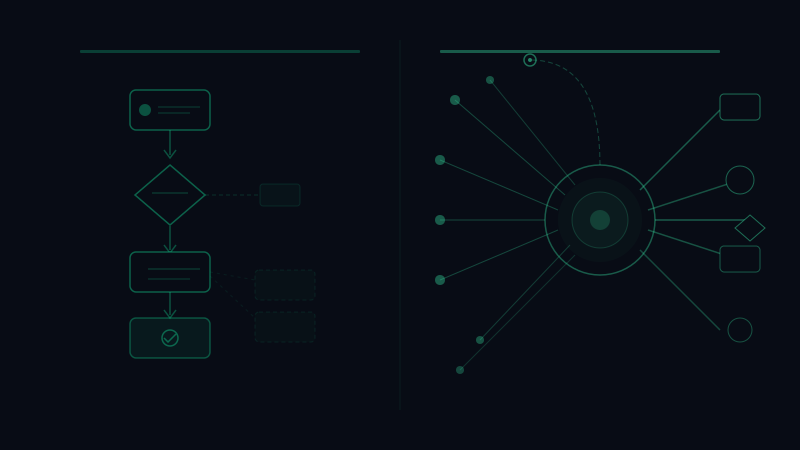
Two different things
AI agents vs automation tools is a comparison that generates more heat than clarity. The terms get conflated, vendors on both sides claim to do everything, and the actual distinction — which is fundamental — gets buried.
Here is the distinction in one sentence: automation tools execute logic you define; AI agents exercise judgment you cannot fully specify in advance.
That difference has enormous practical implications for what you should use, when, and why. This post gives you a concrete framework.
What automation tools actually do
Zapier, Make, n8n — these are workflow automation tools. They are powerful, reliable, and genuinely useful for a large class of operations problems.
The mental model is: triggers, conditions, and actions. When X happens, if Y is true, do Z. You define the logic explicitly. The tool executes it exactly as defined.
This works extraordinarily well when:
- The trigger is clearly defined and machine-readable
- The conditions are enumerable — you can write them all out
- The action is always the same, or drawn from a fixed menu
- The edge cases are known and handleable within the same rule set
A good example: when a new customer signs up, add them to HubSpot, send a welcome email, create a Notion page in the customer folder, and post a notification to #new-customers. Every step is deterministic. The trigger is clear. The actions do not vary. A workflow automation tool handles this perfectly.
Where automation breaks down
The limits appear when any of these conditions fail. When the trigger is ambiguous. When conditions are too numerous to enumerate. When the right action depends on context you cannot fully capture in rules. When edge cases are common and varied.
A customer sends an email with a billing complaint, a product question, and a feature request all in the same message. What is the trigger? Which workflow fires? What is the right action? There is no clean rule for this. The answer depends on the content, the customer's history, the urgency, and the tone — none of which fit neatly into a conditional.
This is where automation tools reach their ceiling.
What AI agents actually do
An AI agent is not a smarter trigger-action system. It is a different kind of thing entirely.
An AI agent reads context, interprets it, makes a decision, and acts on that decision. It does not need you to enumerate every possible condition. It handles variation that you did not anticipate when you set it up.
The mental model: give the agent a role, a scope of authority, access to relevant tools, and a communication channel. The agent reads incoming information, applies judgment to it, and produces action or output — escalating to a human when the situation exceeds its authority.
What judgment means in practice
When your AI support agent receives the message with the billing complaint, the product question, and the feature request:
- It reads the full message and identifies all three threads
- It checks the customer's account status and tier
- It resolves the product question directly from documentation
- It escalates the billing complaint with the account details and the complaint text
- It logs the feature request into the product feedback system with context
None of this was specified as a rule. The agent applied judgment — which is another way of saying it generalized from its training and its role definition to handle a situation that was not explicitly anticipated.
This is the core capability that automation tools do not have.
The framework: which tool for which job
The decision is not "use agents or use automation." For most mature operations stacks, the answer is both — used deliberately for what each does well.
Use automation tools when
The logic is deterministic. If you can fully specify the conditions and actions, automation is faster, cheaper, and more reliable than an agent. Automation tools do not hallucinate. They do not misinterpret. They execute exactly what you defined.
The volume is high and the variation is low. Routing a thousand identical form submissions to the right place is a job for Zapier. The logic does not change per submission; you just need reliable execution at volume.
You need guaranteed behavior. Compliance workflows, financial controls, and audit trails often require that specific actions happen exactly as specified, in a specific sequence, with no variation. Automation tools give you that guarantee.
The edge cases are rare and acceptable. If 98 percent of your inputs fit the rule and the 2 percent that do not can wait for manual review, automation is fine. The failure mode is visible and manageable.
Use AI agents when
Judgment is required. When the right response depends on reading and interpreting unstructured information — emails, messages, support tickets, documents — you need an agent.
The variation is high. When inputs vary significantly and you cannot enumerate all meaningful conditions, rules break down. Agents generalize.
Context matters. When the right action depends on customer history, account status, prior interactions, or organizational context that cannot all be captured in a condition, an agent can hold and apply that context.
You are optimizing for outcomes, not rules. Automation optimizes for executing a rule correctly. An agent optimizes for achieving the desired outcome. When those two are different, use an agent.
Use both when
Most sophisticated operations stacks use both. The AI agent handles the judgment layer — reading inputs, making decisions, determining what to do — and triggers specific automation workflows to execute the deterministic actions.
The support agent decides what category a ticket falls into and what the response should be. An automation workflow handles the actual ticket update in Zendesk, the notification to the relevant Slack channel, and the CRM update. The agent provides the judgment; the automation provides the reliable execution.
This hybrid is usually the right architecture for anything beyond a simple use case.
Common mistakes
Forcing automation to handle judgment. Building elaborate rule trees to handle cases that really require contextual interpretation. The maintenance burden grows without bound, and the edge cases multiply faster than you can write rules.
Using agents when determinism is required. If a specific financial transaction must be processed in a specific way with a specific audit trail, an agent is the wrong choice. The unpredictability of agent output — however small — is unacceptable in compliance-critical flows.
Building agents without escalation paths. An AI agent that cannot recognize when it is out of its depth will make bad decisions silently. Every agent needs defined escalation logic and a communication channel for flagging situations that exceed its authority.
Starting too complex. The right starting point for most teams is to automate the deterministic layer first — clean up the obvious workflow automations — and then deploy agents for the judgment-heavy layer that automation could never handle cleanly.
Hivemeld's position in this stack
Hivemeld is an AI agent platform. It is not a workflow automation tool. But Hivemeld agents can trigger workflow automations — sending structured outputs to Zapier, Make, or n8n when reliable execution of a defined action is what the moment calls for.
The judgment layer and the execution layer are both necessary. Hivemeld provides the former and integrates with the latter.
You can read more about how Hivemeld's agents are structured and deployed in Introducing Hivemeld — Your AI Workforce.
The right question to ask
Before building anything, ask: is the logic for this task fully specifiable? If yes, automate it. If no — if the right answer depends on context, interpretation, or judgment that you cannot reduce to rules — use an agent.
That question will save you more time than any specific tool decision.
If you are ready to deploy agents that handle the judgment layer your automation tools cannot, start here.
Ready to put AI agents to work? Get started with Hivemeld