
AI Content Marketing Automation: A Full Engine, Not a Writing Tool
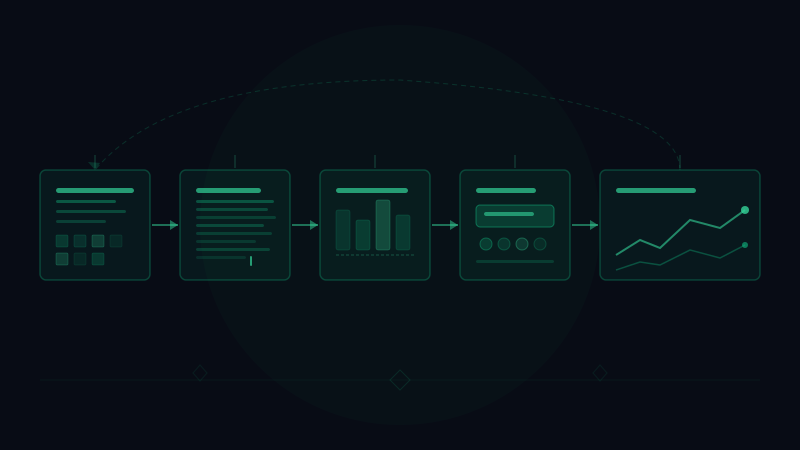
The gap between "AI writes content" and an actual content operation
When most people think about AI content marketing automation, they think about a text generator. You type a topic, you get a draft, you edit it, you post it. The AI saved you an hour. That is useful, but it is not a content operation.
A content operation has a strategy. It has an editorial calendar. It has SEO targets, publishing workflows, distribution steps, and a feedback loop that connects performance data back to future content decisions. When you run this manually with a small team — or alone — it consumes an enormous amount of time that is not being spent on the actual content.
AI content marketing automation, done properly, handles the entire stack. Not just the writing. The strategy, the calendar, the optimization, the publishing, the reporting. You end up with a content engine that runs largely without you — and produces output that is consistently on-brand, targeted, and measurable.
This is the approach behind Hivemeld's AI workforce model: agents that own an entire function, not just a single task within it.
What a full AI content engine looks like
Stage 1: Strategy and editorial planning
Before any writing happens, the agent needs to understand what the content is for. That means keyword research, competitive gap analysis, and aligning content themes with business objectives. A marketing agent configured for this role runs regular planning cycles — weekly or monthly — and produces an editorial calendar with prioritized topics, target keywords, and content formats.
This is not a one-time setup. The agent updates its priorities based on performance data, search trends, and changes in your product or market. Topics that are driving traffic get expanded. Topics that are not performing get deprioritized or reformatted. The strategy adapts.
Stage 2: Writing
The writing phase is where most AI content tools stop, but it is only one stage of the pipeline. The agent writes drafts against a defined brief — target keyword, audience, intent, word count, internal links, tone — and produces structured long-form content that follows your brand's editorial standards.
The quality difference between a generic AI draft and one produced by a properly configured content agent is the brief. When the agent has clear parameters — what the piece needs to accomplish, who it is for, how it fits the broader content strategy — the output is structurally sound. When it is generating content without those parameters, you get generic filler.
Stage 3: SEO optimization
SEO is not just keyword insertion. It is title tag optimization, meta description writing, heading structure, internal link placement, schema markup, and reading-level calibration. A content agent running SEO optimization checks all of these before a piece is published — not as a separate pass you have to remember to do, but as part of the standard publishing workflow.
It also checks for content that already exists on your site that could be competing for the same keyword, and either consolidates or differentiates. Most content teams skip this step because it is tedious. An agent does not skip steps.
Stage 4: Publishing
Publishing is more than clicking a button. It involves formatting for the CMS, adding metadata, setting the canonical URL, scheduling at the right time, and triggering distribution to connected channels. An AI marketing agent handles all of this automatically. You do not need to touch the CMS unless you want to.
For startups without a dedicated CMS manager or marketing coordinator, this is significant. The posts get published consistently, correctly formatted, at the right cadence — without someone manually moving them through the queue.
Stage 5: Reporting and performance analysis
After publish, the agent monitors performance: organic rankings, traffic, time on page, conversion events. It generates regular performance reports and feeds insights back into the editorial planning stage. Topics that outperform expectations get followed up with related content. Topics that underperform get diagnosed — is it the keyword choice? The intent match? The content quality?
This feedback loop is what separates a content engine from a publishing schedule. The system learns and adjusts. It does not just produce content — it produces content that gets better over time.
What this looks like for a startup with no marketing team
Most early-stage startups face the same problem: content marketing is clearly important, but there is no budget for a marketing hire, no bandwidth for the founders to write consistently, and no process for turning sporadic posts into a real channel.
The result is an inconsistent blog, minimal organic traffic, and a dependence on paid acquisition that never gets cheaper.
An AI content marketing agent changes the economics of this. Here is what a realistic configuration looks like for a five-person startup:
Weekly output: Three to five blog posts targeting mid-funnel keywords relevant to your product category. Two to three social posts per platform per week. One email newsletter summarizing the week's content.
Ongoing work: Keyword tracking for target terms. Monitoring competitor content for gaps. Updating existing posts when rankings decline. Building topic clusters around core themes.
Reporting cadence: Weekly performance summary with top and bottom performers. Monthly editorial planning update with next month's calendar.
One agent, properly configured, handles all of this. No hiring, no management overhead, no inconsistent output because someone is on vacation or stretched across other priorities.
The quality question
The most common objection to AI content marketing automation is quality. And it is a fair concern — there is a lot of AI-generated content on the internet that is clearly AI-generated: thin, repetitive, and written for keyword density rather than for readers.
The way you avoid this is not by limiting what the AI writes. It is by building the constraints into the agent's configuration. What sources should it reference? What positions should it take? What depth is expected? What does the brand voice actually sound like in practice?
When those parameters are well-defined, the output quality is high. The agent is not generating filler — it is executing a writing brief with the same discipline a strong freelancer would apply. The difference is it does not need to be briefed every time, because the brief is part of its role definition.
What you still need to do
AI content marketing automation does not make strategy unnecessary. It executes strategy. You still need to decide what markets you are targeting, what your content should communicate about your product, and when to pivot based on business changes.
The agent runs the operation. You run the strategy. That is a reasonable division of labor — and it frees you to spend time on the decisions that actually require your judgment.
A content operation that scales without headcount
The compounding value of a content engine is that organic traffic grows over time. Each piece of content you publish adds to the library, builds topical authority, and creates new entry points for potential customers. The work the agent does in February is still driving traffic in August.
That compounding only happens if you publish consistently. Most startup content strategies fail not because the content is bad, but because the cadence breaks down. Founders get busy, freelancers churn, priorities shift.
An AI content agent does not have bad months. It executes the calendar, week after week, at whatever frequency you configure. The consistency alone is a competitive advantage when most of your competitors are publishing sporadically.
Launch your AI marketing agent on Hivemeld and start building the content operation you have been putting off.
Ready to put AI agents to work? Get started with Hivemeld