
AI Knowledge Management: Building Institutional Memory That Doesn't Leave
Knowledge is the hidden bottleneck
AI knowledge management addresses one of the most underestimated operational problems in growing companies: institutional knowledge is fragile, and it lives in the wrong places.
When your best engineer leaves, their mental model of the codebase leaves with them. When your head of customer success moves on, the deep understanding of your top 20 accounts — the informal history, the workarounds, the relationship context — walks out the door. When a decision gets made in a Slack thread, the reasoning disappears into an archive that nobody searches.
This is not a human failure. It is a systems failure. Most organizations have no reliable mechanism for capturing, organizing, and surfacing operational knowledge. Information accumulates in the wrong places — personal notes, email threads, Slack messages, individual laptops — and the organization rediscovers what it already knew, repeatedly, at significant cost.
An AI knowledge agent is how you fix the systems problem.
What institutional knowledge actually is
Before designing a solution, it is worth being precise about what kind of knowledge matters.
Runbooks and operating procedures — how specific processes actually work, not how they were designed to work. The real sequence of steps. The exceptions. The workarounds. The things everyone knows but nobody wrote down.
Decision history — why specific decisions were made. The reasoning behind the pricing change. Why the integration with that vendor was abandoned. What was tried and failed before the current approach. Without this, teams relitigate decisions constantly.
Product context — how the system works at a level of depth that goes beyond documentation. The historical decisions that shaped the architecture. The technical debt that exists by design and the technical debt that exists by accident.
Customer history — the relationship context, the promises made, the issues encountered and resolved, the sentiment patterns. For enterprise customers, this can span years of interactions across multiple people.
Competitive intelligence — what you know about the market, what you have learned from win/loss analysis, where competitors are moving.
All of this is knowledge your organization generates continuously. Most of it is never captured.
How an AI knowledge agent captures knowledge
The core challenge with knowledge capture is that it needs to be passive. Active knowledge management systems fail because they require humans to interrupt their work to document what they just did. The documentation burden compounds over time, and within months the system is incomplete and unmaintained.
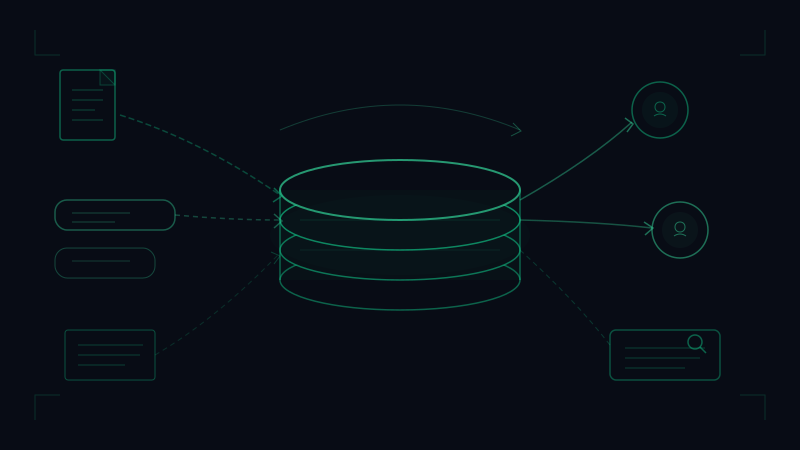
An AI knowledge agent captures knowledge from the places where work actually happens.
Slack and Discord
The most valuable operational knowledge is often created in real-time in your team's messaging channels. A Slack thread where someone explains a technical decision. A Discord conversation where a workaround is discussed. A channel where onboarding issues are diagnosed and resolved.
The knowledge agent reads these conversations — with appropriate permissions — and identifies content worth capturing: decisions made, processes described, problems solved, context shared. It extracts the relevant information, summarizes it, and writes it to the knowledge base in a structured format.
The source conversation is preserved as a reference. The extracted knowledge is made searchable and retrievable by other agents and by humans.
Meeting notes and documents
Call transcripts, meeting notes, and shared documents are high-density knowledge sources. The post-mortem after an incident. The strategy document from last quarter. The onboarding notes from a new enterprise customer.
The knowledge agent ingests these, extracts the structured knowledge, and links it to the relevant entities in the knowledge base: the customer, the product area, the team, the time period. A question asked months later — "what was the reasoning behind the approach to this customer's onboarding?" — can be answered from a meeting note the questioner never knew existed.
Action and outcome data
Knowledge is not just text. It is also the pattern of what actions were taken and what outcomes they produced. When a campaign ran and drove a specific result. When a support approach was tried and generated a measurable change in satisfaction. When a pricing model was tested and what the conversion data showed.
The knowledge agent captures these action-outcome pairs, making them retrievable when similar decisions come up again.
How agents use the knowledge base
A knowledge base is only as valuable as the access layer built on top of it. For an AI workforce, that means retrieval that is fast, accurate, and contextually appropriate.
Contextual retrieval for other agents
When your support agent handles a complex ticket, it queries the knowledge base for relevant customer history, prior issue patterns, and known resolutions. It does not search manually — the query is embedded in the agent's workflow. The knowledge base surfaces the relevant context, and the support agent incorporates it into its response.
When your onboarding agent works with a new enterprise customer, it retrieves what is known about similar customers: which onboarding steps caused friction, which integrations took longer than expected, which features drove the fastest time-to-value.
The knowledge base makes every agent smarter about your specific business — not just about what its base model was trained on.
Human retrieval and search
The knowledge base also needs to be queryable by humans. Not through a folder structure — through natural language search. "What did we decide about the pricing model for enterprise in Q3?" produces a structured answer with sources. "What is the runbook for the payment processor integration?" surfaces the current document and the history of how it has evolved.
This replaces the archaeology expedition that most knowledge retrieval currently requires.
What grows automatically
A well-configured AI knowledge agent produces a knowledge base that grows without a dedicated person maintaining it. Every resolved support ticket adds to the resolution library. Every post-mortem adds to the incident history. Every strategic decision adds to the decision log.
The organization gets smarter over time, automatically. The benefit compounds: the knowledge base is more useful at month six than at month one, and at month twelve than at month six.
This is the inverse of how institutional knowledge typically works, where it peaks when your most experienced people are all still present and degrades as they leave.
What still requires human curation
Passive capture gets you a large volume of potentially relevant information. Human curation determines what is actually authoritative.
Some knowledge needs to be explicitly validated — runbooks, for example, should be reviewed by the people who own those processes before they are marked as authoritative. Decision documents should be confirmed by the decision-makers before they are surfaced as the canonical record.
The knowledge agent handles capture and first-pass organization. Humans handle validation and authorization. The result is a knowledge base with both high coverage (the agent captures continuously) and high reliability (humans validate the critical parts).
Integration with your AI workforce
An AI knowledge agent is most powerful as infrastructure for the rest of your AI workforce. It is not a standalone product — it is the shared memory that makes your agents smarter and more consistent.
You can read more about how Hivemeld structures its agent workforce in Introducing Hivemeld — Your AI Workforce. The knowledge agent is what gives that workforce organizational context — your specific business, your specific customers, your specific operating history.
Without it, agents are generalists. With it, they know your business.
The compounding return
Most operational improvements pay off once. You fix the process, the inefficiency goes away, you move on. Knowledge infrastructure compounds. The return on a well-maintained knowledge base grows with every month of organizational activity it captures.
The right time to start was when the company was founded. The second-best time is now — before another year of decisions, context, and operational knowledge disappears into inaccessible channels and the personal files of people who eventually move on.
If you want to build institutional memory that stays and grows, start here.
Ready to put AI agents to work? Get started with Hivemeld