
AI Meeting Notes That Actually Drive Action Items Forward
Transcription is not the problem
Every meeting tool now offers transcription. The audio becomes text. The text is searchable. This is table stakes and it solves almost nothing.
The problem was never "I cannot remember what was said." The problem is "I cannot find what was decided, who committed to what, and whether any of it actually happened."
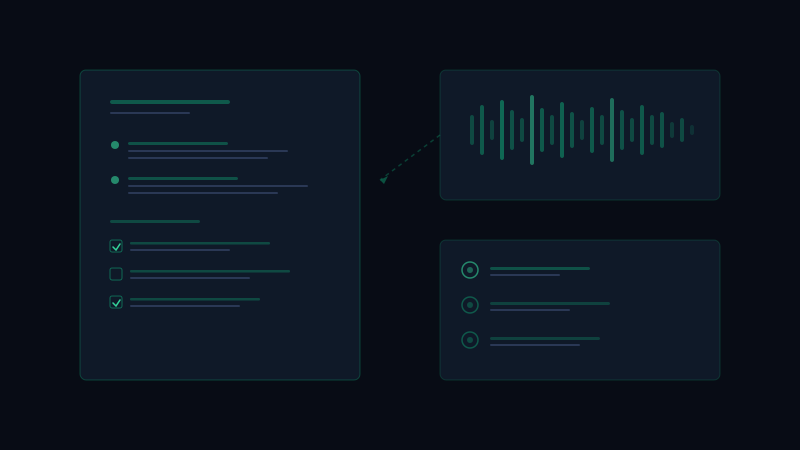
Transcripts give you a wall of dialogue. What you need is structured output: decisions made, action items assigned, deadlines committed to, and a system that follows up when things do not get done.
AI meeting notes are not better transcription. They are post-meeting workflow automation.
What good meeting notes produce
A meeting generates several types of artifact that serve different purposes and different audiences.
Decisions
Every meeting where decisions are made should produce a clear record of what was decided, by whom, with what context. Not the twenty minutes of discussion that led to the decision — the decision itself, stated clearly enough that someone who was not in the room understands what changed.
Decision records prevent the most expensive meeting failure: having the same discussion twice because nobody can confirm what was already decided.
Action items
An action item has four properties: what needs to be done, who owns it, when it is due, and what "done" looks like. A meeting that produces "we should look into that" is not producing an action item. An AI agent extracts the commitments that have all four properties and flags anything that is missing a component.
Context summaries
Not everyone in the organization needs to attend every meeting. But many people need to understand what happened. A two-paragraph summary that captures the discussion themes, key decisions, and open questions gives non-attendees enough context to stay informed without reading a forty-minute transcript.
Follow-up triggers
The most valuable output is the one that connects to what happens next. An action item without a follow-up system is a suggestion. An action item that generates a reminder three days before its deadline, and an escalation if it is not completed, is a commitment with teeth.
The failure mode of manual notes
Every team has tried manual meeting notes. Someone volunteers — or is volun-told — to take notes during the meeting. The quality varies. The format is inconsistent. Key decisions are captured sometimes but not always. Action items are recorded with varying levels of specificity. The notes are posted in a channel where they are read by some attendees and ignored by most.
Then nothing happens. The action items sit in the notes document. Nobody checks whether they were completed. The next meeting starts with "where did we land on that?" and the cycle repeats.
This is not a discipline problem. It is a system design problem. Asking humans to both participate in a discussion and accurately record it is asking them to do two cognitively competing tasks simultaneously. And expecting humans to manually follow up on every commitment from every meeting is asking them to maintain a tracking system that no tool supports.
What AI changes
An AI meeting agent does not participate in the discussion. It observes. This removes the cognitive split that degrades human note quality. It captures everything, categorizes it in real time, and produces structured output immediately after the meeting ends.
Extraction accuracy
Decisions and action items are often implicit in conversation. "So we are going with option B then?" followed by silence or agreement — that is a decision, but it does not announce itself as one. "I will have that ready by Friday" buried in a fifteen-minute discussion — that is a commitment.
An AI agent trained on meeting dynamics identifies these implicit signals. It does not wait for someone to say "let the record show" — it recognizes the patterns that indicate a decision or commitment has been made.
Consistent structure
Every meeting produces notes in the same format. Decisions in one section. Action items in another. Context summary at the top. This consistency means that anyone looking for information knows exactly where to find it, regardless of which meeting generated it.
Immediate availability
Notes are available within minutes of the meeting ending. Not "when the note-taker has time to clean them up." Not "sometime this afternoon." Immediately. This means that follow-up work can start without waiting for documentation.
Persistent tracking
Action items extracted from a meeting do not live only in the notes document. They enter a tracking system. They generate reminders. They appear in the next meeting's pre-read as open items. They are not forgotten because they were buried in page four of last Tuesday's notes.
The follow-through layer
Extracting action items is half the value. The other half is ensuring they get done.
An AI meeting agent with follow-through capabilities does several things that humans consistently fail to do:
Sends reminders before deadlines. Not on the deadline — before it. "You committed to having the pricing analysis ready by Friday. It is Wednesday. Do you need anything to complete this?"
Surfaces incomplete items. In the pre-read for the next meeting: "Three action items from last week are still open. Two are overdue." This creates accountability without requiring anyone to manually check.
Detects patterns. If the same action item appears in three consecutive meetings without being completed, that is a signal. Either the item is not actually a priority, or there is a blocker that has not been addressed. The agent surfaces this pattern.
Connects related items. An action item from Monday's product meeting and a decision from Wednesday's engineering meeting might be related. The agent identifies when separate meetings produce connected or conflicting commitments.
Implementation
Deploying an AI meeting agent on Hivemeld works like any other agent deployment:
- Define the agent's role: meeting documentation and follow-through
- Connect it to your meeting platform (calendar, video tool, or audio feed)
- Specify your output format preferences and where notes should be delivered
- Set follow-up rules: reminder timing, escalation paths, tracking integration
The agent handles every meeting on your calendar by default, or you can scope it to specific recurring meetings. Output goes wherever your team works — Slack, Discord, Notion, your project management tool.
Meeting notes are just one workflow that benefits from always-on AI support. See the full picture in Introducing Hivemeld — Your AI Workforce.
Stop losing decisions to bad notes. Deploy your meeting agent on Hivemeld.
Ready to put AI agents to work? Get started with Hivemeld