
AI Product Feedback Analysis: Build a Roadmap Signal That Actually Works
The Feedback Problem Nobody Has Solved
AI product feedback analysis is one of those things that every product team knows they should be doing systematically and almost none of them actually are.
The feedback is there. It comes from support tickets, NPS survey responses, app store reviews, G2 and Capterra reviews, social mentions, Reddit threads, sales call recordings, customer interviews, and churn surveys. Every channel surfaces signal about what users want, what frustrates them, and what they would pay more for.
The problem is that all of this lives in different places, arrives on different schedules, and requires different tools to access. Making sense of it requires someone to periodically aggregate it all, categorize it, look for patterns, and summarize what they found in a format that product teams can actually use.
In practice, this means that feedback analysis happens irregularly, selectively, and with significant lag. The support team knows about the most common complaints. The sales team knows what comes up in deals. But neither perspective is comprehensive, neither is continuously updated, and neither is synthesized with the other.
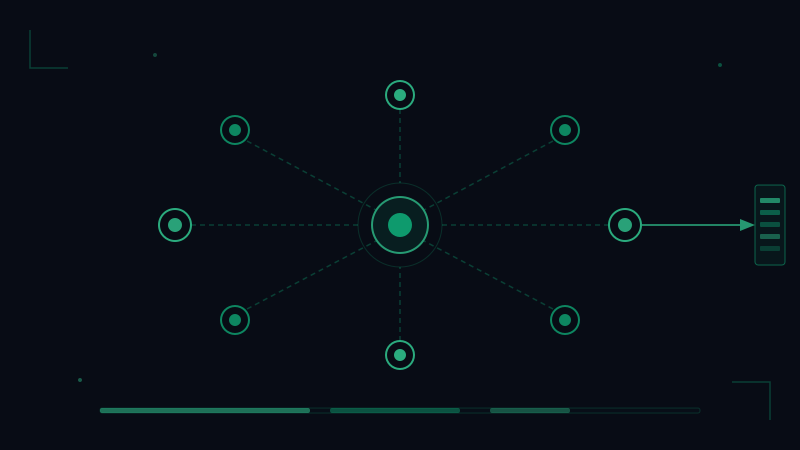
An AI product feedback agent changes the dynamic. It aggregates continuously, categorizes automatically, and surfaces patterns on a schedule — without waiting for someone to have time to do it manually.
Where Feedback Lives
Before you can analyze feedback systematically, you need to know where all of it is.
Support Tickets
Your helpdesk is the highest-volume, most structured feedback source you have. Every ticket is a data point: what the user was trying to do, what went wrong, how they described it, how it was resolved.
Most teams look at ticket volume and resolution time. Fewer look at the content systematically — which categories of issue appear most often, which features generate the most confusion, which tickets get escalated or reopened. An AI agent can do this analysis continuously across thousands of tickets.
NPS and CSAT Surveys
Survey scores matter, but the open-ended responses are where the insight lives. "Needs better export options" buried in a 6-rated NPS response is a product signal. Across a hundred similar responses, it becomes a priority signal.
Manual tagging of survey responses is time-consuming and inconsistent. An AI agent applies consistent categorization at scale, making the qualitative data in your surveys usable for roadmap decisions rather than just sentiment tracking.
App Store and Review Site Reviews
App store reviews and G2/Capterra listings give you unsolicited feedback from users who felt strongly enough to leave a public record. These are not representative samples — they skew toward both very satisfied and very frustrated users — but they surface issues that support tickets sometimes miss, particularly around expectations set during the sales process.
Social Mentions
Twitter/X, LinkedIn, Reddit, and niche community forums surface organic user sentiment that users would never send to your support team. Complaints about a bug, feature requests framed as workarounds, comparisons to competitors — all of this is signal that your current feedback infrastructure probably misses.
Sales Call Recordings
The gap between what users want and what your product currently does often shows up most clearly in sales calls. Prospects who describe their current workflow and then ask "does it do X?" are giving you direct product feedback, filtered through the jobs they are trying to get done.
Sales call analysis is one of the highest-value and least-common feedback inputs to product teams. An AI agent with access to call recordings or transcripts can surface recurring feature requests and objections that your sales team hears but that rarely make it to the product backlog.
How the Analysis Works
Aggregation is the easy part. The value is in what the agent does with the combined dataset.
Categorization
Every piece of feedback gets assigned to a category: feature request, bug report, UX friction, documentation gap, performance issue, pricing concern, integration request. The taxonomy should match your product's structure well enough that the categories are useful for prioritization.
Sub-categorization matters too. "Feature request" is not specific enough. "Feature request: reporting and analytics" points somewhere actionable.
The agent applies this taxonomy consistently, across all sources, without the fatigue or inconsistency that makes manual tagging unreliable at scale.
Pattern Detection
Individual feedback items are anecdotes. Patterns are data.
An agent analyzing feedback over time can surface that a specific user flow generates three times the friction it did six months ago — likely because of a recent product change. It can identify that a particular integration is mentioned as a blocker in sales calls three times more often in Q1 than Q4 of last year. It can show you that the complaint you thought was occasional is actually the most common theme in a specific user segment.
These patterns are what your roadmap decisions should be built on. Individual feedback items, even from important customers, are often noise. The pattern across hundreds of data points is signal.
Priority Scoring
Not all feedback is equally important. Frequency matters, but so does the source, the user segment, and the strategic importance of the request.
A feature request from five enterprise customers is probably more important than one from fifty free-tier users, depending on your business model. A bug that generates ten tickets per day needs a different response than one that has appeared twice in six months.
An AI product agent can weight feedback by source, user segment, account value, and strategic fit — giving your team a prioritized list rather than a raw count.
Continuous Delivery
The most important property of AI product feedback analysis is that it runs continuously. You do not wait until someone has time to pull the data. The synthesis happens automatically and arrives on a defined schedule — a weekly digest for the product team, a monthly summary for leadership, real-time alerts for high-severity issues.
Patterns that take three months to surface in a quarterly feedback review become visible in weeks when the analysis is running continuously.
From Analysis to Roadmap
Feedback analysis has no value if it does not inform decisions. The workflow needs to close the loop.
The Feedback Review
A weekly product feedback review — thirty minutes, standing agenda, structured output from the agent — keeps the team current on what users are saying without requiring anyone to prepare the data. The agent prepares it. The team discusses it.
This review should produce a short list of action items: feature requests to add to the backlog, bugs to prioritize for the next sprint, documentation to update, sales objections to address with positioning changes.
Backlog Tagging
Feedback patterns should be traceable to backlog items. When an engineer asks why a feature is prioritized, the answer should include the feedback data that supported the decision. When you ship something that addresses a common request, you should be able to close that feedback loop with the users who raised it.
Connect your feedback categorization to your project management tool. The agent's output should flow into your backlog, not just into a Slack channel.
The Feedback Changelog
One of the highest-trust signals you can send to your users is "we heard you and we built it." A feedback changelog — a public or internal record of which product decisions were driven by user feedback — closes the loop with users and creates accountability for the process internally.
It also makes the feedback system self-reinforcing. Users who see their feedback acted on give more feedback. The signal improves.
What AI Analysis Cannot Replace
AI product feedback analysis surfaces what users say. It does not tell you what users need.
The distinction matters. Users often describe problems in terms of solutions they have already imagined. "I want a bulk export button" might actually be "I need to get my data into another system without manual effort." The feature request is a symptom. The underlying need is what your product strategy should address.
Surfacing that underlying need requires talking to users directly — watching them use the product, asking follow-up questions, sitting in on their workflow. No amount of ticket analysis replaces a good user interview.
The AI agent handles the systematic layer: aggregation, categorization, pattern detection, prioritization. Your product team handles the interpretive layer: what does this pattern mean, what is the user actually trying to do, and what is the right solution. Both layers are necessary.
Hivemeld deploys AI agents across product, support, marketing, and every other department. See how the system connects in Introducing Hivemeld — Your AI Workforce.
Ready to build a feedback loop that actually informs your roadmap? Deploy your AI product agent on Hivemeld.
Ready to put AI agents to work? Get started with Hivemeld