
The AI Startup Operations Playbook: What to Automate and When
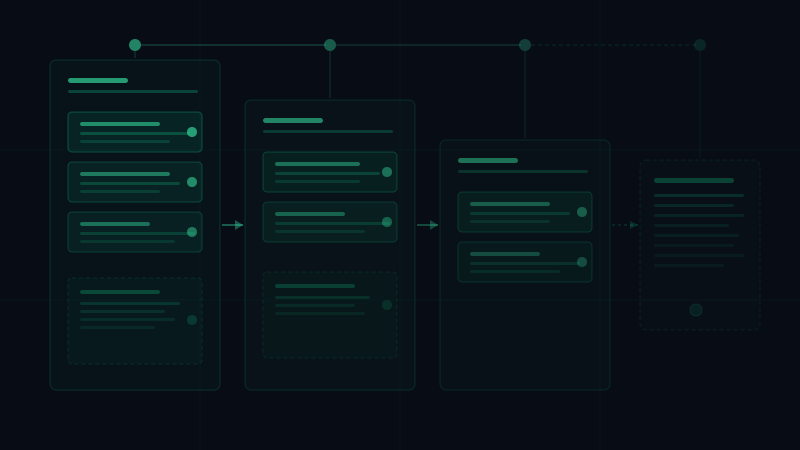
Sequencing is the strategy
Every startup founder who has looked seriously at AI agents has had the same thought: we could automate so much of this. Customer support, content, sales follow-up, engineering monitoring, finance reporting — all of it has some version of an AI agent that could be doing the work.
The question is not whether to automate. The question is what to automate first, what to automate second, and what to leave human for now. Get the sequence wrong and you either automate the wrong things (leaving your highest-leverage work manual) or automate too aggressively too fast (creating a system you cannot observe or correct).
AI startup operations is not a destination. It is a build. You add layers incrementally, validate each one, and expand from a position of confidence rather than optimism.
This playbook gives you the sequencing framework. It is based on a simple principle: automate what is high-volume, low-variance, and low-risk-if-wrong first. Work toward what is lower-volume, higher-variance, and higher-stakes.
The Hivemeld AI workforce model is designed for exactly this kind of incremental deployment — starting with a single agent and building toward a coordinated operation.
Wave 1: The Foundation (Automate First)
Customer support — tier-1
Start here. Tier-1 support is the highest-volume, most repetitive work in most startups, and the cost of an agent making an error is low — a bad response gets corrected by a human escalation, and the feedback loop is tight.
An AI support agent handling billing questions, account access, and feature confusion does not need to be perfect on day one. It needs to be better than no response at all, and it needs to know when to escalate. Start with a narrow scope — two or three ticket categories — and expand as you calibrate the agent's accuracy.
The benefit is immediate: 24/7 coverage, faster resolution on routine tickets, and your team's attention freed for complex issues.
Infrastructure monitoring
The second foundation piece. An AI monitoring agent watching your uptime, error rates, and latency costs almost nothing to deploy and the downside of not having it — a production issue that sits undetected for hours — is real.
Start with alert triage: the agent contextualizes incoming alerts, filters noise, and escalates genuine incidents. You do not need it making decisions about remediation yet. You need it to make sure the right person knows about the right problem quickly.
This is low-risk automation with high-confidence returns. Deploy it before anything else in the engineering stack.
Content publishing pipeline
The third wave-one candidate. A content agent that executes a defined publishing calendar — writing posts against briefs, optimizing for SEO, publishing on schedule — operates with low variance if you have a clear strategy to give it.
The agent is not making strategic decisions in wave one. It is executing the strategy you have already defined. That is a safe place to start. You review outputs before they go live (or review after, once you trust the quality), and you tighten the brief as you learn what the agent does well and what it needs more guidance on.
Wave 2: The Operations Layer (Automate Second)
Once wave one is running reliably — typically 4-8 weeks after initial deployment — you have established the habits of working with agents: reviewing outputs, adjusting configurations, trusting the escalation paths. Wave two extends automation into functions that are higher-stakes and require more calibration.
CRM and sales operations
A CRM automation agent handles contact enrichment, activity logging, sequence management, and deal-risk detection. The variance here is higher than tier-1 support — every deal is different, and the right follow-up depends on context that is sometimes hard to standardize.
Start the sales agent with administrative work: enriching new contacts, logging activity from email and calendar integrations, updating deal stages based on detected signals. These are tasks where the cost of an error is low and the agent has clear data to work from.
Add sequencing and re-engagement messaging once you trust the administrative layer. Review a sample of sequences before fully delegating, and calibrate the agent's voice and timing against your rep's judgment.
Financial reporting and monitoring
A finance agent monitoring burn rate, invoicing status, and expense categorization is genuinely useful — and genuinely higher-stakes than support or content. A miscategorized expense is a real problem. An invoice that gets sent to the wrong entity is a real problem.
Deploy the finance agent in a monitoring and reporting role first. It observes, categorizes, and reports. It does not execute transactions autonomously. The weekly burn summary and cash runway update do not require human judgment to compile, but they benefit enormously from being compiled accurately and consistently.
Add transaction automation — automated invoice generation, payment reminders, expense processing — only after you have validated the agent's accuracy in the monitoring role for at least a month.
PR review and engineering operations
Extending the engineering agent from alert triage to PR review and deployment coordination is wave two work. PR review requires the agent to make quality judgments about code — low-stakes for style and convention checks, higher-stakes for logic review.
Start with first-pass review on a subset of PR types: frontend style checks, documentation completeness, test coverage against a defined standard. These are objective enough that the agent's accuracy is easy to validate. Add more complex review criteria as you calibrate against your senior engineers' standards.
Wave 3: Strategic Coordination (Automate Later)
Wave three is multi-agent coordination: agents working together to handle complex operations that span functions. A marketing agent briefing a content agent. A support agent triggering an engineering response. A sales agent notifying finance when a deal closes.
This is where AI startup operations starts to look like an actual operating system rather than a collection of tools. But it requires the foundation — the individual agents, configured and calibrated — to work.
Do not attempt wave three until wave one and wave two agents are running reliably. The coordination overhead of multi-agent workflows is real, and debugging a coordination failure is much harder than debugging a single agent.
When you do build wave three, start with one handoff. Two agents, one connection. Validate it. Add complexity from there.
What to keep human
There are functions that should remain human-owned, at least for now.
Hiring and team decisions: Evaluating candidates, making offers, and managing people are relationship-intensive and high-stakes. An agent can help screen applications and schedule interviews. It should not be evaluating cultural fit or making hiring recommendations.
Major strategic decisions: Pricing changes, pivots, fundraising strategy, and market positioning are decisions that require judgment about your specific situation that no agent currently has the context to make well. Use agents to gather information and prepare analysis. Make the decisions yourself.
High-value customer relationships: Enterprise accounts, partnerships, and customers at risk of churning often need a human voice. An agent can manage the day-to-day, draft the communications, and flag the situations. The sensitive conversations should be human-to-human.
Legal and compliance matters: Anything that creates legal exposure should have human review. The agent can draft. A human should approve before anything legally significant is sent or filed.
The mindset shift
Running a startup on AI agents requires a different operating mindset than running it with a human team. With humans, you delegate and trust, then check in periodically. With agents, you configure and monitor, then adjust the configuration when you see something off.
The early weeks of deploying each agent should involve close observation — reviewing outputs, checking escalation decisions, tightening the role definition. As confidence builds, the monitoring interval lengthens. A well-calibrated agent does not need daily oversight. It needs occasional review and configuration updates when circumstances change.
The goal is not to remove yourself from operations. It is to move your attention from the execution layer to the strategy and exception layer. The agents run the operations. You run the agents — and you focus your own time on the work that requires your judgment.
Building the AI operations layer incrementally
The mistake most founders make is treating AI operations as an all-or-nothing project — either you have a fully automated startup or you are doing everything manually. Neither is true.
Start with one agent. Run it for a month. Add a second agent. Connect them when both are stable. Extend the scope of each agent as you calibrate their judgment. The operation grows in capability without growing in complexity faster than you can manage it.
At the end of that process, you have a startup that runs on fewer people, operates more consistently, and scales without linear headcount growth. That is the compounding return on sequencing this correctly.
Start building your AI operations layer on Hivemeld — deploy your first agent today and build from there.
Ready to put AI agents to work? Get started with Hivemeld