AI Budget Automation: Beyond Tracking
Budgeting apps have been promising to fix personal finance for fifteen years. Most of them do one thing reasonably well: they show you where your money went after it's already gone.
This is not nothing. But it's a long way from what people actually need, which is a system that's actively working on their behalf — watching for problems, flagging things that need attention, and surfacing insights before the month closes and the opportunity to act has passed.
AI budget automation closes that gap. Not by building a better dashboard, but by replacing passive tracking with active financial management.
The Problem with Passive Tools
Every major budgeting app operates on the same basic model: it connects to your accounts, categorizes your transactions, and shows you the results. The value is visibility. You can see that you spent more on dining this month than you planned, that subscriptions have crept up, that a category you thought was under control is actually running hot.
Visibility is useful. It is not the same as management.
The distinction matters because visibility requires you to do something with it. You have to check the app, interpret what you see, decide what it means, and take action. Every one of those steps is something that can and does get dropped. You had a busy week. You forgot to check. The month ended. Nothing changed.
A passive tool is only as good as your attention to it. For most people, their attention is already fully allocated.
What an Active AI Finance Agent Does Differently
An AI finance agent — actual AI budget automation, not just a smarter dashboard — operates continuously and proactively. It's not waiting for you to log in and review your spending. It's monitoring your transactions, running analysis, and reaching out when something needs your attention.
The difference in practice:
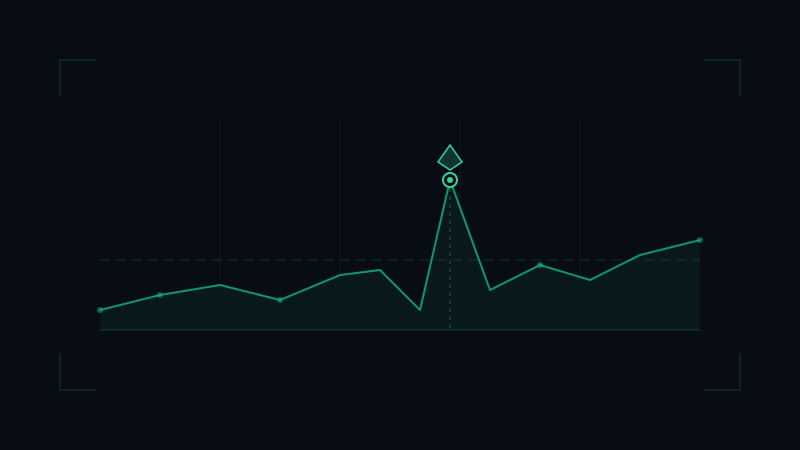
Anomaly detection. A restaurant charge that's three times what you normally spend there. A subscription you've been charged for that you thought you cancelled six months ago. A recurring payment that changed amount without notice. These get flagged and brought to you, rather than buried in a transaction list you scroll through occasionally.
Pattern recognition. Your grocery spending has increased 22% over the last three months. Your utility bills are seasonal but this month is running unusually high for the time of year. Your streaming subscriptions total $187/month across nine services. These patterns exist in the data — an active agent surfaces them instead of leaving you to find them.
Forward-looking alerts. Based on your spending pace through the 15th of the month, you're tracking to exceed your dining budget by about $140. This is useful information on the 15th. On the 31st, it's just history.
Categorization That Actually Works
One of the chronic frustrations with budgeting tools is transaction categorization. A charge from a merchant with a truncated name goes to "Other." A legitimate business expense gets filed under entertainment. A healthcare copay lands in the wrong category. You spend twenty minutes every month re-categorizing transactions that should have been right the first time.
AI categorization improves this materially. With enough context about your spending patterns, your accounts, and your stated preferences, an AI finance agent can categorize transactions accurately at rates that make manual review largely unnecessary. And when it's unsure, it asks — once, learns the answer, and applies it going forward.
From Tracking to Insights
There's a level above accurate categorization and anomaly detection that most budgeting tools never reach: synthesis.
Not "here's your spending by category." But: "Your net savings rate has dropped from 18% to 11% over the past four months. The primary driver is dining and delivery, which is up 34%. At this trajectory you'll fall short of your Q3 savings goal by approximately $2,400 unless you course-correct."
This is financial insight. It requires understanding what you've told the system matters to you — your savings goals, your financial timeline, your upcoming large expenses — and connecting that to what's actually happening in your accounts.
An AI finance agent maintains this context persistently and synthesizes it into something you can act on rather than data you have to interpret yourself.
Handling Subscriptions and Recurring Charges
The subscription economy has made this problem worse. The average person has more recurring charges than they realize, many of them forgotten, some of them for services no longer used. These rarely get audited because the individual amounts feel small even when the aggregate is significant.
An AI finance agent handles subscription monitoring as a continuous background task. It tracks every recurring charge, notes any changes in amount, identifies services you haven't used recently (if connected to usage data or app history), and can flag candidates for cancellation. The output is an actionable list, not a spreadsheet you built yourself.
The Difference Between Automation and Abdication
A common concern about AI budget automation is loss of control — handing your finances to a system and losing visibility into what's happening.
This is worth taking seriously, but it reflects a misunderstanding of the model. An AI finance agent doesn't make financial decisions for you. It handles the monitoring, categorization, pattern detection, and surfacing that currently requires your sustained attention — and brings the outputs to you in a form that makes your decisions faster and better-informed.
You still set the parameters. You still approve anything consequential. The agent handles the operational layer so that when something actually needs your judgment, you're not starting from scratch with raw transaction data.
How Hivemeld Approaches Financial Management
Introducing Hivemeld describes the broader platform, but the financial management capability illustrates the core principle: there's a class of work that's important, recurring, and genuinely demanding of attention — but that doesn't require your judgment at every step.
Financial monitoring is that kind of work. The data needs to be watched. Patterns need to be detected. Anomalies need to be flagged. But you don't need to personally review every transaction to accomplish any of that. An agent does it continuously, and you engage with the outputs — the alerts, the summaries, the recommendations — not the raw inputs.
The result is that your finances get more attention, not less. Just not all of it from you.
What You're Actually Getting
A passive budgeting tool gives you a mirror: a reflection of what already happened. An AI finance agent gives you something closer to a financial controller — a system that watches, flags, synthesizes, and brings you what actually needs your attention.
The decisions stay yours. The monitoring, the pattern detection, the anomaly flagging, the subscription audit — those move off your plate permanently.
Put Your Finances on Active Management
Hivemeld monitors your spending, flags what matters, and surfaces insights before they become problems.
Ready to put AI agents to work? Get started with Hivemeld