
Building Trust With Your AI Agents: The Calibration Period
Trust is not a setting
You cannot configure trust. You cannot install it. It does not arrive with the product.
Trust between a person and an AI agent is built the same way trust is built between people: through repeated interactions where expectations are met, mistakes are acknowledged and corrected, and reliability compounds over time.
This is the calibration period — the first two to four weeks with a new agent where you are actively testing, correcting, and expanding the boundaries of what the agent handles. It is not a limitation of the technology. It is a feature of how reliable delegation works.
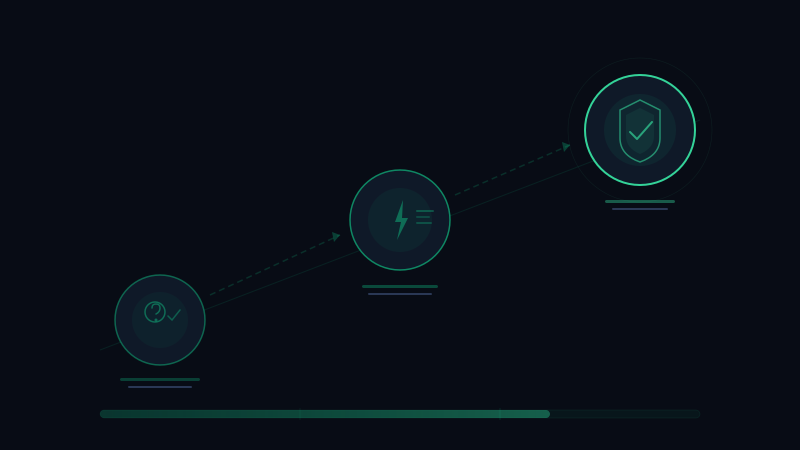
The trust ladder
Trust develops in stages. Each stage has different characteristics and different expectations.
Stage 1: Propose and confirm
The agent proposes. You confirm. Every action requires your explicit approval before it executes.
"I would schedule your dentist appointment for Tuesday at 2pm. Should I proceed?" "Here is a draft meal plan for the week. Would you like me to finalize it?" "Three emails look like they need responses today. Here are my suggested replies for your review."
This stage feels slow. That is intentional. You are building a baseline understanding of how the agent interprets your requests, what quality level it produces, and where its judgment aligns with yours.
Duration: Typically one to two weeks for each task category.
Stage 2: Act and report
The agent acts, then tells you what it did. No pre-approval, but full transparency.
"Scheduled your dentist appointment for Tuesday at 2pm. Confirmation attached." "Finalized this week's meal plan. Grocery list sent to your preferred store." "Responded to three routine emails this morning. Summaries below."
You review after the fact. If the agent got something wrong, you correct it and the correction updates its model. Mostly, you skim the reports and move on.
Duration: Typically two to four weeks, until corrections become rare.
Stage 3: Act silently
The agent handles its responsibilities without reporting unless something unusual happens. You see the results — the appointment on your calendar, the meal plan in your app, the emails in your sent folder — but you do not receive a notification for each one.
The agent still reports edge cases: "A scheduling conflict came up that I could not resolve automatically. Here are your options." But routine execution happens in the background.
Duration: Ongoing, once trust is established for a given task category.
What accelerates trust
Some behaviors make the calibration period shorter and the trust ladder easier to climb.
Consistency
An agent that performs at the same level every time builds trust faster than one that is brilliant sometimes and mediocre others. Predictability is more important than peak performance during calibration. You need to know what to expect.
Transparency about uncertainty
When an agent says "I am not sure about this — here are two options, and here is why I am uncertain" — that builds trust faster than an agent that confidently makes a wrong choice. Acknowledging limits demonstrates good judgment.
Clean error handling
Agents make mistakes. How they handle mistakes matters more than whether they make them. An agent that catches its own error, explains what happened, and proposes a fix builds more trust than one that either hides errors or requires you to discover them.
Scope awareness
An agent that stays within its defined role builds trust. An agent that expands its scope without permission erodes it. If you hired a meal planning agent and it starts offering financial advice, that is a trust violation — even if the advice is good.
What erodes trust
Trust erosion is asymmetric. It takes weeks to build and moments to break. These are the behaviors that set you back:
Silent failures. The agent was supposed to do something and did not, without telling you. You discover the failure when a deadline passes or someone asks about something that should have been handled. This is the most damaging failure mode because it undermines the fundamental premise of delegation: that delegated work will get done.
Overconfidence. The agent presents uncertain conclusions as certain ones. It schedules something you would not have approved. It sends a message in a tone you would not have used. It acts beyond its authority without acknowledging that it is doing so.
Inconsistency. The agent handles similar situations differently without explanation. Tuesday's email triage uses different criteria than Thursday's. The meal plan follows your constraints one week and ignores them the next. You cannot predict what it will do, so you cannot trust it to do things unsupervised.
Ignoring corrections. You tell the agent not to schedule meetings before 10am. Next week, there is a 9am meeting on your calendar. Failing to incorporate feedback is a fundamental trust violation because it means the calibration process is not working.
Rebuilding after a trust break
If trust erodes — because of a significant error, a pattern of inconsistency, or scope creep — the path back is straightforward: move back down the trust ladder.
Return to "propose and confirm" for the task category where trust was broken. Re-establish the baseline. Verify that corrections are incorporated. Then progress back through the stages.
This is not a failure. It is the system working. Trust is not permanent for humans and it is not permanent for agents. It requires ongoing calibration.
Trust as a feature
Hivemeld is designed with the trust ladder in mind. New agents start in propose-and-confirm mode by default. You explicitly advance them to act-and-report, and then to silent execution, as your confidence grows.
You can also move an agent back down at any time. Changed your preferences? New life circumstances? Want more visibility for a while? Adjust the trust level. The agent adapts.
This is not about limiting the AI's capability. It is about matching the AI's autonomy to your comfort level — and recognizing that comfort is earned, not assumed.
Trust is built through use. Start the calibration with your first agent and experience how quickly reliability compounds. See the vision in Introducing Hivemeld — Your AI Workforce.
Ready to start building? Create your Hivemeld account.
Ready to put AI agents to work? Get started with Hivemeld