
How Autonomous AI Agents Actually Work
The phrase "autonomous AI agents" has been everywhere lately, and most of the coverage falls into one of two failure modes: breathless hype with no substance, or technical documentation written for engineers. Neither is useful if you want to actually understand what these systems are and how to work with them.
This is the explanation in the middle — conceptually rigorous, no jargon required.
What an Agent Actually Is
An AI agent is a software system that pursues a goal over time, using tools, making decisions, and adjusting based on results — without requiring a human to approve each step.
The key word is over time. Most AI interactions are single-turn: you send a message, the AI responds, the interaction ends. An agent is different. It receives a goal, breaks it into steps, executes those steps in sequence, handles failures and exceptions, and reports back when the task is complete (or when it genuinely needs you).
Think of the difference between asking someone a question and assigning them a project. The first is a transaction. The second is delegation. Autonomous AI agents are built for delegation.
The Four Components of Any Agent
1. Role and System Prompt
Every agent has a defined role — a set of instructions that establishes who it is and what it's responsible for. This is called a system prompt, and it's where behavior is shaped.
A well-designed system prompt tells the agent its purpose, its constraints, its decision-making priorities, and how to handle edge cases. A calendar agent might be instructed to never double-book, always protect morning focus hours, and default to video calls for external meetings. These rules don't need to be re-explained every time — they're part of the agent's permanent operating parameters.
Think of the system prompt as the agent's job description and operating manual combined.
2. Task Backlog and Memory
Agents work from a task queue — a structured list of what needs to be done, in what order, with what dependencies. When you assign a goal, the agent breaks it into discrete steps and manages that list itself.
Memory is what makes an agent useful over time rather than just once. A sophisticated agent stores context: your preferences, past decisions, recurring patterns, and the outcomes of previous tasks. A travel agent that remembers you prefer aisle seats and dislike red-eye flights doesn't need to be told again. It applies that knowledge automatically.
Memory comes in two forms: short-term context (what happened in this task) and long-term storage (what it knows about you across all tasks). The combination is what makes an agent feel like a capable assistant rather than a search interface.
3. Tool Use
An agent without tools is just a language model talking to itself. Tools are what allow agents to interact with the actual world.
Tools can include: web search, calendar APIs, email systems, database queries, payment processors, booking platforms, document editors, communication apps, and more. When a travel agent finds a flight, it's not imagining a flight — it's calling an airline API, parsing real data, and making a decision based on actual availability and pricing.
The range of tools an agent can use determines the range of tasks it can complete. This is why platform design matters enormously in the autonomous AI agents space. An agent with access to 50 integrations is fundamentally more capable than one with access to 5 — not because it's smarter, but because it can act in more places.
4. Decision Logic and Escalation
A competent agent doesn't just execute instructions — it makes judgment calls within defined boundaries and knows when to stop and ask.
This is where the "autonomous" part gets nuanced. True autonomy isn't about an agent that never checks in. It's about an agent that handles everything it's qualified to handle, and only escalates genuine decision points. A grocery agent should reorder your coffee without asking. It should ask before switching to a different brand if your preferred one is out of stock.
Well-designed escalation logic is what separates a useful agent from an annoying one. The agent should be invisible for the 95% of situations it handles cleanly, and visible only for the 5% where your judgment is actually needed.
How Multiple Agents Work Together
Single agents are useful. Multi-agent systems are where the real leverage appears.
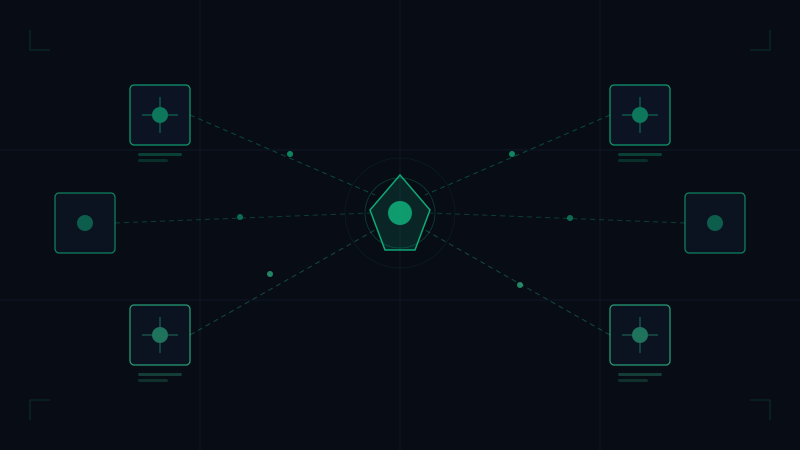
In a personal AI workforce, different agents own different domains — travel, nutrition, finance, scheduling, communications — and coordinate with each other. When your calendar agent schedules a work trip to Chicago, it notifies the travel agent to book flights and hotels, the finance agent to check the budget, and the meal planning agent to note the dietary disruption. No human coordination required.
This is the architecture behind Introducing Hivemeld: not one generalist AI, but a coordinated team of specialized agents, each operating in their domain, sharing context with each other.
The coordination layer is what makes this more than a collection of chatbots. Shared memory, inter-agent messaging, and priority queues allow the system to behave coherently as a whole, not just competently in isolation.
What Agents Are Not
Not Infallible
Agents make mistakes. Good agent design includes verification steps, human checkpoints for high-stakes actions, and logging so you can review what happened. The goal is to be reliably useful, not perfect.
Not Black Boxes (By Design)
A well-built agent system is auditable. You should be able to see what task an agent completed, what tool it used, and what decision it made at any branch point. Opacity is a design choice, not a technical necessity — and it's usually a bad one.
Not a Replacement for Your Judgment
The agent decides when to buy more paper towels. You decide whether to change careers. The appropriate scope of delegation matters, and good agent systems are designed with that boundary clearly defined.
Why This Architecture Matters Now
The reason autonomous AI agents are genuinely useful today — rather than just theoretically interesting — is the convergence of three things: language models capable of reliable reasoning, widespread API availability across consumer and business platforms, and cloud infrastructure that makes persistent, always-on execution practical.
All three have crossed a threshold. The result is that the gap between "AI that can assist" and "AI that can act" is now small enough to build products around.
Understanding how agents work isn't just intellectually interesting — it changes how you think about what to delegate and how to structure goals. An agent asked to "handle my travel" will underperform an agent given specific parameters: budget range, preferred airlines, advance booking minimums, hotel criteria. The technology is capable; the leverage comes from knowing how to direct it.
Put Autonomous Agents to Work
Hivemeld deploys a coordinated team of autonomous AI agents across the domains that consume your time — scheduling, meal planning, travel, grocery, finance, communications. Each agent is purpose-built for its domain, equipped with the tools it needs, and designed to escalate only when your judgment genuinely matters.
Ready to put AI agents to work? Get started with Hivemeld