
Multi-Agent AI Workflows: Orchestrating Agents Without Creating Chaos
When a single agent is not enough
A single AI agent is powerful. It can own a function — content marketing, customer support, CRM operations — and run it autonomously with minimal oversight. But most business operations are not isolated functions. They are interconnected. A content decision affects the sales team's messaging. A support escalation might require an engineering response. A lead entering the pipeline triggers both marketing and sales activity.
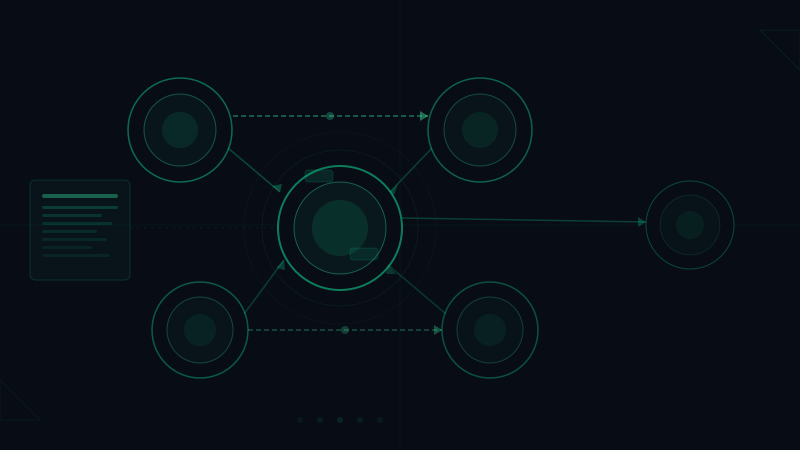
Multi-agent AI workflows are how you handle this complexity: multiple agents with distinct roles, coordinating with each other to complete operations that span more than one function. A marketing agent that briefs a content agent. A support agent that escalates to an ops agent. A sales agent that notifies a finance agent when a deal closes.
Done well, multi-agent workflows extend the power of individual agents across your entire operations layer. Done poorly, they create a coordination mess that is harder to manage than the manual processes they replaced.
This post covers the coordination patterns that work, the failure modes to avoid, and how Hivemeld structures agent-to-agent workflows to keep complex operations under control.
The fundamental challenge of agent coordination
Single agents are relatively straightforward to reason about. They have a defined input, a defined scope, and defined outputs. You can trace what they did and why.
Multi-agent systems introduce coordination risk. When Agent A hands off to Agent B, who is responsible for the quality of the work that crosses the boundary? When Agent B produces output that Agent A needs to act on, how does A know the output is trustworthy? When two agents are both working on related tasks, how do you prevent them from producing conflicting outputs?
These questions are not theoretical. They are the practical problems that make multi-agent workflows difficult to deploy in production.
The answer to all of them is the same: explicit coordination protocols. The handoffs, the communication channels, the authority rules, and the escalation paths between agents need to be as carefully designed as the individual agent roles themselves.
Coordination patterns that work
Sequential pipelines
The simplest multi-agent pattern is a sequential pipeline: Agent A produces output that becomes the input for Agent B. A content strategy agent produces an editorial brief. A content writing agent takes the brief and produces a draft. A publishing agent takes the draft and handles distribution.
Each agent in the chain has a clearly defined input and output format. The handoff is explicit and auditable. If something goes wrong, you can trace which stage in the pipeline produced the bad output.
Sequential pipelines work best when the workflow has a natural linear structure — when stage N always follows stage N-1 and the output of each stage is unambiguous.
Event-triggered coordination
Not all coordination is sequential. Some agent workflows are triggered by events rather than by position in a pipeline.
A support agent handles a tier-1 ticket. That ticket reveals a bug — a condition the support agent is configured to recognize. The support agent does not fix the bug. It fires an event: "Bug detected in checkout flow — details attached." The engineering agent picks up that event and creates a ticket in the sprint board.
Neither agent is managing the other. They are both responding to a shared event stream, handling the portion of the response that falls within their role. The coordination happens through the event, not through a direct handoff.
Event-triggered coordination is more flexible than sequential pipelines and scales better to complex operations where multiple agents might respond to the same trigger.
Hierarchical delegation
In more complex configurations, one agent can delegate to another the way a manager delegates to a direct report. A marketing agent is responsible for the overall content strategy. It creates a brief and assigns it to a content agent, which executes the writing. The marketing agent reviews the output before publishing.
This pattern maintains a clear accountability structure. The marketing agent is responsible for the final output — not just its own work, but the work of the agents it delegates to. That agent-level accountability mirrors how human teams work: the manager is accountable for the team's output, not just their own.
The risk in hierarchical delegation is the review step. If the reviewing agent's quality bar is not well-calibrated, it either accepts bad work or creates a bottleneck by rejecting too much. Calibrate the review criteria explicitly in the reviewing agent's role definition.
Failure modes to design around
Communication explosion
When agents can freely message each other, they will. Volume scales quadratically with the number of agents — N agents can produce N² communication channels. This creates noise, makes the system hard to observe, and can cause agents to get stuck in feedback loops.
Design communication protocols that limit what agents communicate to each other and through which channels. Agents should not be having open-ended conversations with each other. They should be passing structured outputs and firing structured events.
Circular dependencies
Agent A is waiting for output from Agent B. Agent B is waiting for a signal from Agent A. The system deadlocks. This is easy to accidentally build when workflows are complex.
Map your agent dependencies before you deploy. Every edge in the graph — "Agent A feeds Agent B" — should be a directed edge. If you draw the graph and find a cycle, you have a design problem. Break the cycle by introducing a human checkpoint or by restructuring which agent owns which part of the workflow.
Responsibility gaps
When multiple agents touch the same process, responsibility can fall through the cracks. Neither agent owns what happens at the boundary between them.
Define ownership explicitly for every piece of work. A document, a lead, a ticket, a deploy — at any given moment, one agent (or one human) should be unambiguously responsible. When work crosses a boundary, the handoff should be explicit and logged.
Conflicting outputs
Two agents working independently on related tasks can produce outputs that contradict each other. A marketing agent writes a blog post positioning a feature one way. A sales agent writes follow-up email copy positioning the same feature differently. The prospect experiences inconsistency.
Prevent this by giving agents access to shared context — a source of truth for product positioning, brand voice, current priorities — and by routing outputs that touch the same domain through a coordination agent or a human review step.
How Hivemeld handles agent-to-agent workflows
Hivemeld's architecture is built around the idea that agents communicate through structured channels, not ad-hoc messaging. Each agent has a defined output format. When work crosses an agent boundary, the handoff happens through a logged event that both agents can reference.
This makes multi-agent workflows auditable. You can see what Agent A produced, what it passed to Agent B, and what Agent B did with it. When something goes wrong, the trace is there.
Agent-to-agent communication in Hivemeld runs through the same records as human-agent communication — structured handoffs written to the action log, with escalation paths defined in each agent's role configuration. A support agent escalating to an engineering agent does so through the same mechanism as a support agent escalating to a human engineer. The routing is determined by the escalation rule, not by which end of the handoff is human or AI.
This design choice matters: it keeps the system simple to observe and simple to intervene in. You do not need to understand a separate agent coordination protocol. You see the activity in the same channels you already monitor.
Starting with two agents before adding more
The impulse when building multi-agent workflows is to design the full system upfront — a complete org chart of agents, all the handoffs mapped out, the entire operation running autonomously on day one.
This is how you end up with a system that is impossible to debug.
Start with two agents and one handoff. Run it in production until you trust it. Understand how the handoff works, what good output looks like, and what failure modes have appeared. Then add a third agent. Extend the workflow one step at a time.
The complexity budget for a multi-agent system is real. Each additional agent adds coordination overhead. Add agents when the marginal value of the new agent exceeds the marginal cost of coordinating it.
The power of agents working together
The ceiling on what AI can do for your operations rises significantly when agents can coordinate. A single support agent can handle tier-1 tickets. A support agent and an engineering agent working together can identify, triage, and track bugs surfaced through support — without a human playing coordinator in the middle.
That is a qualitatively different kind of leverage.
Multi-agent AI workflows are where the AI workforce model stops being a collection of individual tools and starts being an actual operating system for your business.
Build your multi-agent workflow on Hivemeld and start connecting your AI workforce into something that compounds.
Ready to put AI agents to work? Get started with Hivemeld