The New Work-Life Balance Is AI-Handled Admin
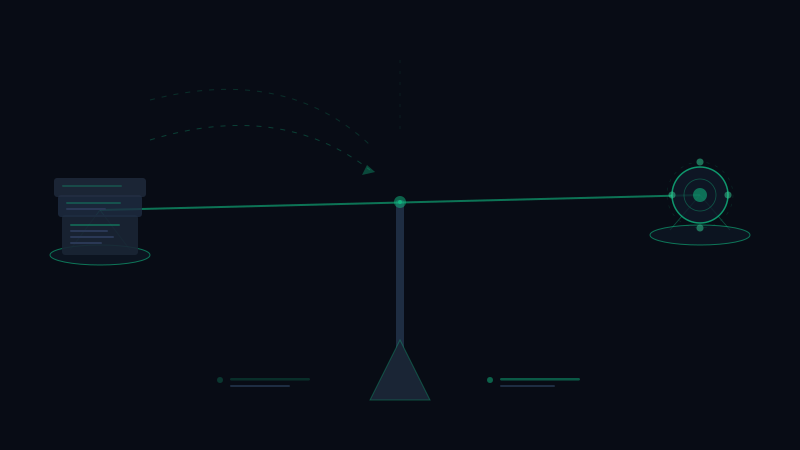
The balance problem has been misdiagnosed
The conventional framing of work-life balance treats it as a time allocation problem. You have a fixed number of hours. Work takes too many of them. You need to work less, or protect personal time more aggressively, or get better at saying no.
This framing is wrong, or at least incomplete. The hours are not the primary problem. The bleed is.
Work bleeds into personal time not because there are too many hours of it, but because the administrative layer of work — the emails to triage, the meetings to schedule, the reports to prepare, the research to compile, the follow-ups to send — does not fit neatly into working hours. It is ambient. It colonizes evenings and weekends and the mental space that is supposed to be for other things.
Work-life balance AI automation addresses the bleed directly. Not by reducing work hours, but by removing the administrative layer that causes most of the overflow in the first place.
What the administrative layer actually contains
To understand what AI can handle, it is worth being specific about what the administrative layer includes. For most knowledge workers, it looks something like this:
Email triage. Scanning inboxes for things that require a response, flagging urgent items, archiving noise, and drafting replies to routine requests. This does not require strategic judgment — it requires pattern recognition and attention, both of which AI handles well.
Scheduling. Coordinating meeting times across multiple parties, managing calendar conflicts, blocking focus time, sending calendar invites, and rescheduling when things shift. The overhead of scheduling is wildly disproportionate to its value.
Research and briefings. Before a meeting, call, or decision, compiling background information, competitive context, or relevant data. This is skilled work, but it is delegatable skilled work — the kind that consumes hours without requiring your specific expertise.
Reporting. Weekly status summaries, monthly metrics compilations, project progress updates, and stakeholder communications. The thinking behind these reports matters. The assembly of them does not require you.
Follow-up and tracking. Remembering what you said you would do, logging what was agreed, and ensuring that commitments are honored on both sides. This is relationship capital disguised as administrative work.
Each of these categories is independently significant. Combined, they constitute the layer that causes the bleed.
What AI handles, and what it does not
The important distinction is between work that requires your specific judgment and work that requires execution on a pattern you have already established.
Strategy requires your judgment. The decision about which direction to take a project, which client to prioritize, how to respond to a difficult situation — that is yours. Nobody can delegate judgment without delegating authority, and delegating authority to an AI is a different question than delegating administration.
But the email that explains a scheduling conflict? The summary of last week's project activity? The research briefing before the board call? The follow-up to the vendor who missed a deadline? These are execution tasks. They follow patterns. They can be delegated.
Work-life balance AI automation draws a clean line at that boundary. The AI handles the execution layer. You handle the judgment layer. The judgment layer fits into working hours. The execution layer used to consume the margins of your personal time. It no longer does.
The scheduling problem specifically
Scheduling deserves special attention because it is the administrative task that bleeds most visibly.
A single meeting involves at minimum: the initial request, the exchange of availability, the confirmation, the calendar invite, the location or video link setup, and frequently a rescheduling cycle. Multiply this by the number of meetings in a week. The communication overhead of scheduling a full meeting load can consume several hours — time that contributes no value beyond coordinating time.
An AI scheduling agent handles all of this. It knows your calendar, your preferences for meeting density and placement, your focus block priorities, and your typical constraints. It negotiates availability with counterparties through email or whatever channel they prefer. It books, confirms, and manages the logistics. You appear at the scheduled time.
The cognitive load of scheduling — holding competing time slots in your head, tracking pending confirmations, managing the anxiety of a packed calendar — disappears along with the execution overhead.
Email triage without inbox zero theater
Inbox zero is a performance. The goal was never a clean inbox — the goal was confidence that nothing important was missed and that obligations were tracked. An AI triage agent delivers that without the daily ritual.
It reads every incoming message and makes a judgment based on your stated priorities and learned behavior: this requires your immediate attention, this requires a response today, this can wait until next week, this is noise that can be archived. It drafts responses to the routine messages and queues them for your approval. It flags anything that needs a judgment call.
Your interaction with email shifts from processing to review. You scan the flagged items, approve or edit the drafted responses, and make the actual decisions. The processing — reading everything, categorizing, deciding what needs to happen — is handled.
This is a meaningful shift in how work feels. Not just in time saved, but in the reduction of ambient anxiety that comes from knowing there are messages you have not gotten to. The AI has gotten to them. You know what needs your attention.
Research that arrives before you ask for it
The briefing that prepares you for a meeting, the competitive context before a pitch, the background on a new contact before a first call — this research compounds into significant hours across a week. More importantly, when it does not happen because there was not time to prepare, you walk into conversations less effective than you should be.
An AI research agent does this work continuously. It knows your schedule and your role. Before the board meeting, the briefing appears. Before the call with a new client, the contact research arrives. Before the quarterly review, the performance data is compiled. You receive the relevant context at the moment you need it, without tasking anyone or asking for it yourself.
As described in Introducing Hivemeld, this is what separates an AI workforce from an AI assistant: the work happens proactively, not in response to prompts. The agent knows what you need and prepares it.
The reclaimed margin
When the administrative layer is handled, what comes back is not just time — it is the specific kind of time that is most valuable and most scarce. The evening hours that used to be spent triaging email become genuinely personal time. The mental space that used to be occupied by pending follow-ups and unread messages becomes available for actual rest.
This is the version of work-life balance that is actually achievable: not fewer working hours, but cleaner boundaries between when you are working and when you are not. The work that requires your attention gets your full attention during working hours. The administration that previously leaked into everything is handled by systems that run continuously without your supervision.
The bleed stops because the material that was bleeding out has somewhere else to go.
Building toward the new balance
The transition to AI-handled administration is not instantaneous. The first week, you are supervising closely — reviewing the AI's triage decisions, editing its drafted responses, correcting its calendar management. By the end of the first month, the supervision is lighter. By the end of the third month, you are reviewing output rather than checking work.
The endpoint is a working life where your hours contain the things that require you, and the things that do not require you are handled — completely, accurately, and without your attention.
That is the new work-life balance. Not a better ratio of hours. A better allocation of judgment.
Reclaim your margin
Deploy a Hivemeld admin agent and stop letting the administrative layer colonize your personal time.
Ready to put AI agents to work? Get started with Hivemeld