
From One Agent to a Team: A Practical Scaling Playbook
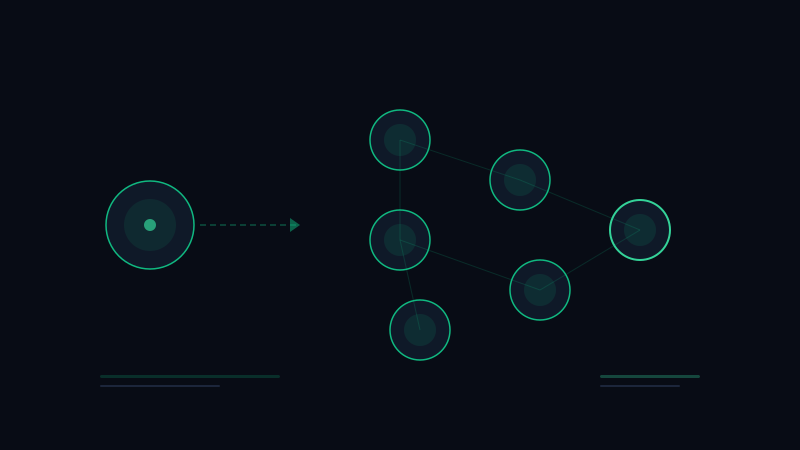
One agent is a tool. A team is an organization.
The jump from one agent to several is bigger than it looks. One agent is a tool you operate. A team of agents is a small organization you run — with coordination, handoffs, shared context, and failure modes that do not exist when there is only one. Most deployments that stall do so right here, because the operator scales the count without scaling the structure.
The good news is that the playbook is well understood, because it is the same playbook that works for human teams. The difference is that with agents you can execute it in days instead of quarters.
Don't scale until the first agent is boring
The single most common scaling mistake is adding the second agent while the first is still unreliable. If you are still babysitting agent one, adding agent two does not double your output. It doubles your babysitting.
The signal that you are ready to scale is boredom. When the first agent runs for a week and you barely think about it — when its output is consistent enough that you have stopped reviewing every action — you have a stable unit to build on. Stability in the first agent is what makes the second one additive instead of just more work.
If the first agent is not boring yet, the fix is not more agents. It is a sharper role, tighter guardrails, or a smaller scope. Get to boring, then grow.
Grow along the seams of the work
When you do add agents, add them where the work naturally divides — along its seams, not down its middle.
Work divides cleanly when the pieces require different competencies, run on different cadences, or touch different tools. Support and engineering are different seams: different skills, different rhythms, different systems. Splitting one overloaded support agent into "tier-one triage" and "complex escalations" can also be a clean seam, because the two do genuinely different work.
What does not divide cleanly is a single coherent task chopped in half for volume. Two agents each doing half of one person's job will spend more effort coordinating than they save. If you find yourself splitting by volume rather than by competency, the answer is usually a higher budget for one agent, not two agents.
Make context shared, not copied
The hardest problem in a multi-agent team is the same as in a human team: keeping everyone working from the same picture. When agents operate from private, divergent context, they make locally sensible decisions that are globally contradictory — the support agent promises a feature the engineering agent just deprioritized.
The fix is a shared source of truth that every agent reads from and writes to. A shared backlog so work is visible across roles. A shared knowledge base so decisions and rationale persist. A common action log — in Hivemeld, the one every agent writes to — where activity is recorded somewhere every agent and every human can read it. The goal is that no agent has to guess what another is doing, because it can look.
Shared context is what turns a pile of agents into a team. Without it, you have parallel workers who happen to share a logo.
Wire handoffs explicitly
In a one-agent system there are no handoffs — the agent starts and finishes everything. In a team, handoffs are where work moves and where it most often breaks. An agent that finishes its part and drops the result into a void has not actually completed the chain.
A clean handoff has three properties. The receiving agent gets the full context, not a summary that strips the detail it needs. The handoff is logged, so a human can see where work is and where it stalled. And there is a clear owner at every moment — work is never in the ambiguous state of "between agents" with nobody responsible.
Wire these deliberately. The support agent that spots a bug files it to engineering's backlog with the reproduction steps attached. The engineering agent that ships the fix marks the ticket resolved so support can close the loop with the customer. Each wired handoff removes a coordination meeting you would otherwise have to run.
Keep approval gates at the team boundary
As the team grows, resist the urge to gate every internal handoff. Agent-to-agent work, inside a team you have tuned, should flow. The gates belong at the boundary between the team and the outside world — the customer-facing send, the public post, the production deploy, the spend over a threshold.
This keeps your oversight where the risk actually is. Internal coordination is reversible and cheap; external action is where mistakes become visible and expensive. Gate the boundary, let the interior run, and your attention stays concentrated on the decisions that matter as the team gets bigger.
Watch the team-level metrics
A single agent is easy to judge — it works or it does not. A team needs metrics that capture the system, not just the parts.
Throughput per agent tells you who is carrying load. But the team-level signals are more telling: how long work sits between agents (handoff latency), how often a chain stalls because an agent is waiting on another, and whether the spend-to-output ratio holds steady as you add agents or quietly degrades. A team that adds agents but flattens output has a coordination problem, not a capacity problem — and the metrics will say so before you feel it.
Add the next agent the same way you added the first
Scaling is not a one-time event. It is the first playbook, run again: identify the bottleneck, define the role sharply, deploy it with generous guardrails, get it to boring, then wire its handoffs into the team. Each addition follows the same loop, and each one is a little easier because the shared context and the gates are already in place.
The teams that scale agents well are not the ones who deploy the most. They are the ones who keep each addition stable before making the next, who grow along the seams of the work, and who invest in shared context and clean handoffs early. Do that, and going from one agent to ten feels less like managing chaos and more like watching an organization quietly come together — one boring, reliable agent at a time.
Ready to put AI agents to work? Get started with Hivemeld