
How Small Teams with AI Agents Compete with Fifty
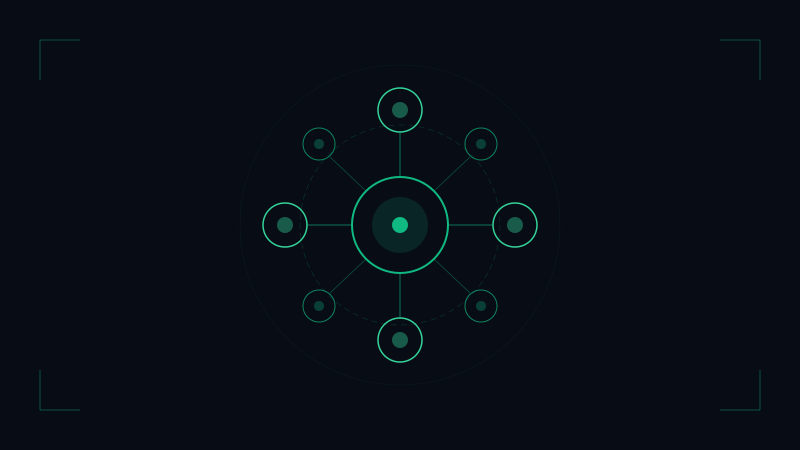
There is a quiet transformation happening inside small companies. Teams of five are outpacing competitors three times their size. They are shipping faster, responding to customers more reliably, and maintaining financial discipline that most growth-stage companies struggle with. The difference is not work ethic. It is leverage — specifically, AI agents for small teams that handle entire operational domains without adding a single employee.
This is not theoretical. It is the new baseline for founders and operators who understand what they are working with.
The Headcount Illusion
For decades, scaling a company meant scaling headcount. More revenue meant more hires. More hires meant more coordination, more management overhead, more HR complexity. The relationship was mostly linear and painful.
AI agents break that relationship.
When you deploy an AI workforce, you are not replacing people with robots — you are separating the work that requires human judgment from the work that requires human availability. Most of what burns through a small team's time falls into the second category: answering routine support tickets, drafting weekly marketing copy, reconciling expenses, scheduling follow-ups, monitoring KPIs. These are availability tasks, not judgment tasks. An AI agent handles them permanently.
What remains for your five humans is the judgment work — strategy, relationships, creative direction, exception handling. That is where your team's energy should go. An AI workforce makes that possible.
What Each Agent Actually Does
The best way to understand this is to walk through an actual AI workforce structure for a small company. This mirrors how Introducing Hivemeld describes the platform's approach: a coordinated team of specialized agents, not a single chatbot.
Marketing Agent
Your marketing agent is not writing one-off blog posts on request. It is maintaining a content calendar, publishing on schedule, monitoring which topics are driving engagement, and adjusting the editorial direction based on that data. It drafts social content across platforms, sends outreach emails, and surfaces opportunities — a podcast that fits your audience, a newsletter that might feature you, a keyword cluster your competitors are not covering.
For a five-person team, this means the company has a consistent content presence without a content manager. The marketing agent runs in the background. You review and approve at a high level. The output keeps shipping.
Customer Support Agent
A 24/7 support function is unrealistic for a small team. An AI support agent makes it the default. It reads and triages every inbound message, resolves the issues it can resolve with access to your knowledge base and account data, escalates what needs a human, and follows up to confirm resolution. Response times drop to seconds. Customer satisfaction climbs. Your team fields a fraction of the tickets.
The agent learns from escalations over time. The category of issues it can handle independently expands. You get better coverage with less involvement.
Operations Agent
Operational work is the most invisible drain on a small team. Scheduling, vendor coordination, inventory tracking, compliance reminders, recurring reporting — these tasks are low-skill but high-frequency. An operations agent absorbs them.
It monitors your operational metrics, flags anomalies, reminds owners of pending deadlines, and drafts the status updates that would otherwise consume a Friday afternoon. You stop firefighting small operational fires because the agent catches them early.
Finance Agent
A finance agent gives a small company CFO-level visibility without a CFO. It tracks cash flow against projections, monitors burn rate, categorizes expenses, flags unusual transactions, and surfaces the financial questions that deserve your attention. At month-end, it reconciles accounts and drafts the financial summary you would otherwise spend hours compiling.
For founders who came up through product or engineering, the finance agent is often transformational — it makes the financial layer legible without requiring you to live in spreadsheets.
The Coordination Layer
Individual agents are useful. A coordinated workforce is something else.
The power of an AI workforce is not any single agent — it is how they interact. Your marketing agent knows about the product launch your operations agent is tracking. Your finance agent flags the budget impact of a campaign your marketing agent is running. Decisions made in one domain are visible to the agents working in adjacent domains.
This is the difference between isolated tools and an actual workforce. The coordination layer is what allows a five-person company to operate with the situational awareness of a company ten times its size.
What This Is Not
AI agents do not replace the humans who set direction. They do not handle genuinely novel situations well. They do not build the relationships that close enterprise deals or recruit great people to your team. Complex legal questions, investor conversations, high-stakes partnership negotiations — these remain human work.
The founder who thrives with an AI workforce is not the one who tries to automate everything. It is the one who is honest about which work is truly judgment-intensive and which work is availability-intensive, and routes each category to the appropriate resource.
When you get that allocation right, five people becomes fifty in output.
The Competitive Math
Consider the actual cost comparison. A full-time marketing manager, support specialist, operations coordinator, and part-time bookkeeper — fully loaded with benefits, tools, and overhead — represents significant annual spend and significant management attention. An AI workforce covers equivalent functional territory for a fraction of that cost and none of the management overhead.
The freed budget can go toward the hires that actually compound: a second great engineer, a senior salesperson who can close enterprise accounts, a head of design who elevates everything you ship.
Small teams are no longer small because they lack resources. They are small because they choose to be — and that choice, backed by an AI workforce, is now a competitive advantage.
Start Building Your AI Workforce
Hivemeld gives you a coordinated AI workforce — marketing, support, operations, and finance agents working together, managed from a single interface. See what your five-person team can do.
Ready to put AI agents to work? Get started with Hivemeld