
Which Team to Deploy First: Building an AI Org Chart
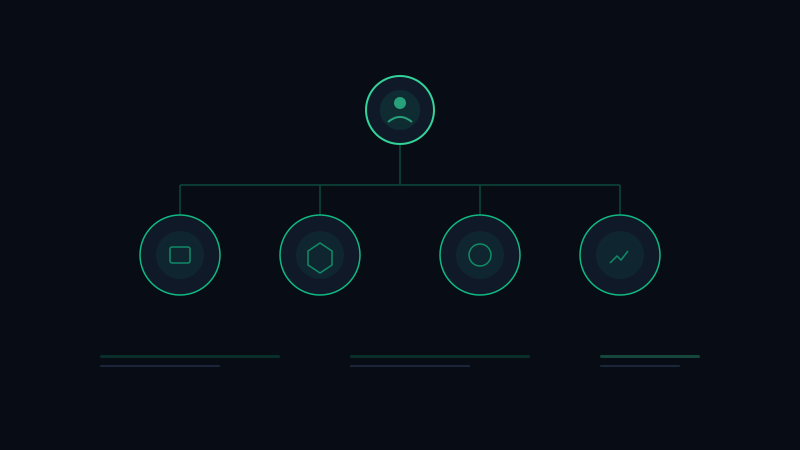
Start with the bottleneck, not the wish list
The instinct, once you can deploy AI teams for any department, is to deploy all of them. Resist it. A company that stands up six teams in week one spends week one supervising six teams — and supervision is the exact work you were trying to offload.
The better move is to treat your AI org chart the way a thoughtful operator treats hiring: one department at a time, starting with whatever is currently costing you the most hours or the most revenue. For most companies at this size that is not the glamorous function. It is the one quietly eating evenings and producing no leverage.
So before you name a team, write down where last quarter actually went. Not where you wanted it to go — where it went. The team you deploy first should map directly to the biggest line on that list.
The usual first three
For most companies between ten and two hundred people, the order lands in a predictable place.
1. Sales or Marketing — whichever is your constraint. If you have demand and cannot work it fast enough, Sales first: research, outbound, meeting prep, deal coaching, pipeline hygiene. If you have capacity and not enough demand, Marketing first: content drafted and scheduled, campaigns, social, spend reporting. One of these is almost always your binding constraint, and you know which.
The deeper reason to start here is that both run on the same system of record, and standing either one up gets your CRM maintaining itself from Gmail and Outlook. That foundation makes every later team better, because they read current data instead of a stale import.
2. RevOps. Once a GTM team is running, the thing that limits it is data quality and the absence of anyone to analyse the funnel. RevOps is the team with the clearest unattended wins: forecasting, win/loss analysis, quota attainment, and the hygiene work that makes the rest mean anything. It is also low-risk — the failure mode of a data-hygiene agent is a field that has to be reverted, visibly, in a click.
3. Customer Success or Support. Interrupt-driven, repetitive, and time-sensitive is the worst possible combination for a small team trying to do deep work. Renewal prep, health monitoring, onboarding checks, ticket triage. By this point you have a maintained record for every account, which is what makes a renewal brief worth reading.
Notice what is not on this list. No "CEO agent," no strategy team, and Engineering not until per-customer isolation is finished rather than before. Anything that makes expensive, irreversible calls comes later, if at all.
Define the team before you deploy it
The mistake that turns an org chart into chaos is deploying a team without a sharp definition. "Help with marketing" is not a department. "Draft and schedule two LinkedIn posts per weekday from the product backlog, never publish a customer name without approval, never spend above $200 without approval" is a department.
A good team definition reads like a job description written for someone competent who has never met you:
- Scope — what it owns, stated as concrete recurring work.
- Tools — exactly which systems it can read, which it can write to, and which are out of reach.
- Authority — what it may do without asking, as thresholds and lists rather than adjectives.
- Escalation — the conditions that bring a person in. Hivemeld's defaults are spend over a limit, a kind of action not yet cleared, a weak read of the agent's own evidence, and any account you have flagged.
- Done — what a finished piece of work looks like, so the agents know when to stop.
The tighter you write it, the less you supervise. Vague scope generates questions; sharp scope generates output.
Wire the handoffs
A real org chart is not just boxes. It is the lines between them, and the lines are how work moves between teams without routing through you.
The support agent that spots a recurring bug files it to engineering's backlog. The RevOps agent that finds a renewal with no activity hands it to CS. The marketing agent that publishes a launch notifies ops to watch for the traffic. Each of these is a handoff, and each handoff you wire is a status meeting you no longer run.
Two rules make this work. Handoffs go through a visible record rather than a direct call, so a person can see what was passed and stop it if it looks wrong. And you wire them only once each team is reliably doing its own job — connecting unstable teams just propagates mistakes faster. Stabilise the boxes, then draw the lines.
Design your own role deliberately
Leadership does not disappear from the org chart. It moves to the top of it, where it belongs: setting direction, making the calls that are expensive to reverse, and reading output rather than producing it.
That means deciding on purpose which decisions require a person. A publish to the homepage. A refund over a threshold. A production deploy. A discount past a floor. Anything touching your five largest accounts. Write that list; everything not on it flows.
The goal is not zero involvement. It is involvement concentrated on judgment instead of scattered across tasks. A useful diagnostic: at the end of a week, look at what reached your Decisions inbox and ask how many of those you read carefully. If it was all of them, your gates are right. If you clicked through most, routine work is leaking into the gate and the thresholds should move.
And if you find yourself doing something an agent could have done, that is not a failure of the agent. It is a missing line in the chart.
Grow by scope before headcount
When a team is humming, you will feel the pull to add the next one. Before you do, look at what the running team has revealed. Often it surfaces work nobody realised they were doing — and the right next move is to widen that team's scope rather than stand up a new department. A support team that has learned your product well is the natural owner of onboarding too.
Add a new box only when the work genuinely belongs to a different competency, on a different cadence, touching different systems. That is the same instinct that stops a human company from hiring a generalist for every gap.
The chart is a living document
Your AI org chart on launch day will not be the one you run in six months, and that is correct. Scope splits as volume grows. Lines get redrawn as you learn which handoffs matter. Some agents get retired because the work they did stopped mattering.
The companies that get the most out of this treat the chart as something they revise on a schedule — a monthly review of what each team owns, what it should hand off, whether the thresholds are still right, and whether the handoffs reflect how work actually flows. Run that review and the chart keeps earning its place. Skip it and you drift back toward supervising everything yourself.
Start with the constraint. Define the team sharply. Draw the lines once the boxes are stable. Keep leadership at the top doing the judgment work. That is an org chart that scales — whether you are twelve people or about to be two hundred.
Ready to put AI agents to work? Get started with Hivemeld