
When Not to Use AI Agents: Knowing the Boundaries
The enthusiasm trap
When you first experience the leverage that AI agents provide, the instinct is to apply them everywhere. Every task, every workflow, every decision — surely an agent could handle it faster, cheaper, and with less effort.
This instinct is mostly correct. Most of what consumes your time can be delegated. But "most" is not "all," and the cases where AI agents are the wrong tool are important to recognize. Using agents where they do not belong produces worse outcomes than doing nothing — and it erodes trust in the system for the cases where agents are genuinely excellent.
Where agents should not go
High-stakes interpersonal communication
An agent can draft an email. It should not send a condolence message, negotiate a salary, deliver difficult feedback to a team member, or navigate a sensitive client conversation without your direct involvement.
These interactions depend on genuine human connection, emotional intelligence, and the specific relational context between you and the other person. An agent that sends a perfectly worded sympathy message on your behalf is not the same as you sending an imperfect but genuine one. The recipient can tell the difference — maybe not immediately, but eventually.
Use agents to draft. Review before sending. And for truly personal communication, write it yourself.
Novel strategic decisions
Agents excel at applying known preferences to repeatable decisions. They struggle with decisions that are genuinely novel — where the right answer depends on judgment, intuition, incomplete information, and the ability to reason about situations unlike anything in the training data.
"Should I take this job?" "Should we enter this market?" "Is this the right time to raise prices?" These decisions benefit from information gathering (which an agent can help with), but the decision itself requires your judgment about your specific situation, risk tolerance, and goals.
Creative work that defines your identity
If your creative output is what makes you you — your writing voice, your design aesthetic, your musical sensibility — then delegating it to an agent means delegating your identity. The output might be competent, but it will not be yours.
This is different from creative support work. An agent that researches topics for your blog, organizes your notes, or formats your manuscript is supporting your creative process. An agent that writes the blog posts themselves is replacing it.
The line is personal and it moves over time. But it exists, and crossing it means something.
Tasks where the process is the point
Exercise. Cooking a special meal. Reading to your children. Writing in a journal. Playing music. Some activities produce outputs that could theoretically be automated, but the point of doing them is the doing — not the output.
An agent could generate a weekly journal summary. But journaling is valuable because the act of writing clarifies your thinking. Automating it eliminates the benefit.
Identify the activities in your life where the process itself is valuable and protect them from optimization.
Decisions requiring accountability
When something goes wrong, someone needs to be accountable. If an AI agent makes a decision that harms a client, damages a relationship, or violates a regulation, the accountability still falls on you. You cannot delegate accountability along with the decision.
For decisions where the consequences of failure are significant and the accountability matters — legal decisions, medical decisions, financial decisions above a certain threshold — use agents for analysis and preparation, but make the decision yourself. The agent provides the input. You own the output.
The support vs. replacement distinction
The right framework is not "should an agent do this task?" It is "should an agent own this task, or should an agent support me in doing this task?"
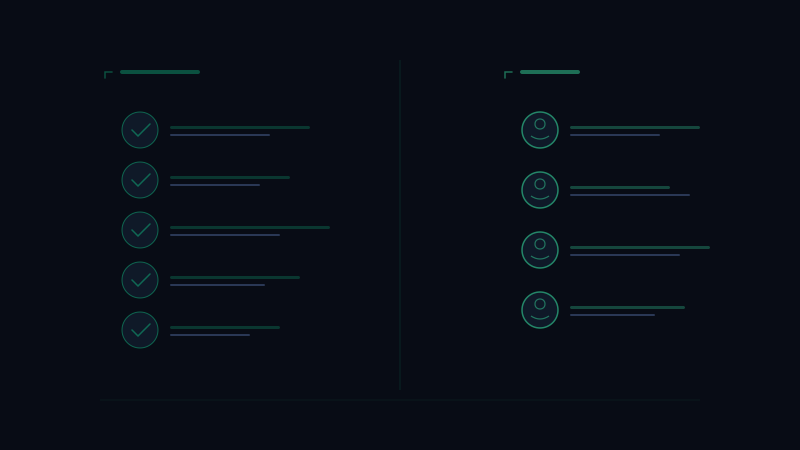
Agent owns: Scheduling, meal planning, email triage, invoice management, data organization, routine communication, research gathering, status reporting.
Agent supports: Strategy development, creative work, relationship management, high-stakes decisions, sensitive communication, novel problem-solving.
In the "supports" category, the agent does the preparation work, provides analysis, drafts options, and organizes information. You do the thinking, deciding, and communicating. The agent makes you faster and better-informed. It does not replace your judgment.
The over-delegation warning signs
How do you know if you have delegated too much?
You cannot explain why a decision was made. If someone asks why you chose a particular approach and your answer is "my agent decided," you have lost the thread. You should always understand — and be able to articulate — the reasoning behind important decisions, even if an agent prepared the analysis.
Your relationships feel transactional. If every interaction in your life goes through an AI layer first, the warmth and spontaneity that make relationships work can erode. Not every message needs to be optimized.
You feel disconnected from your own life. If your calendar, meals, finances, and communication are all managed by agents and you are just approving recommendations, you might feel more like a passenger than a participant. Some operational involvement keeps you connected to the details of your own life.
The quality of creative output declines. If you are delegating creative work and the output is competent but lacks the distinctive qualities that made it yours, you have crossed the line from support to replacement.
Finding your boundary
The right boundary between delegation and personal involvement is individual. It depends on what you value, what you are good at, what energizes you, and what drains you.
A useful exercise: list everything you did last week. For each item, ask: "Would I lose something meaningful if an agent did this instead of me?" The items where the answer is yes — those are yours to keep. Everything else is a candidate for delegation.
The goal of AI agents is not to remove you from your life. It is to remove the operational burden so you can be more present for the parts that matter to you.
Hivemeld is designed with these boundaries in mind — agents that enhance your capacity without replacing your judgment. See the philosophy in Introducing Hivemeld — Your AI Workforce.
Ready to delegate the right things? Start with Hivemeld.
Ready to put AI agents to work? Get started with Hivemeld