
AI SDRs Aren't Coming to Save You. Here's What Actually Works.
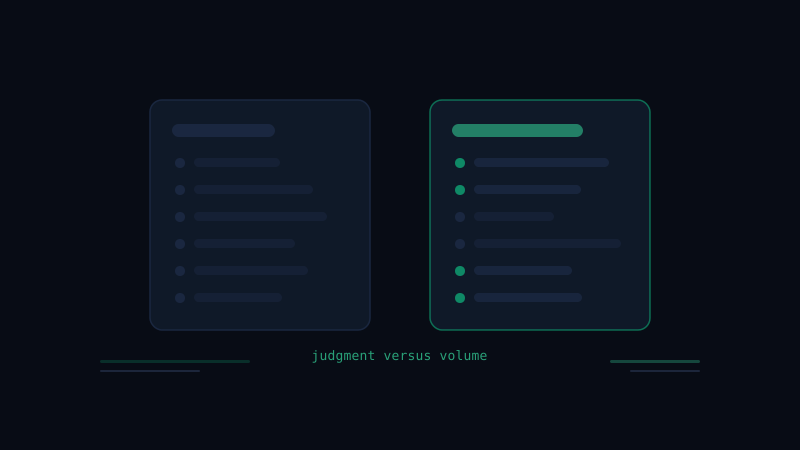
The demo is great. An autonomous AI SDR that researches prospects, writes outreach, runs sequences, and books meetings while you sleep. Then it goes live, and your company starts sending the worst email your prospects receive all week.
The promise, and what actually ships
The pitch was headcount replacement. Fire up the digital SDR, point it at a list, pay a fraction of a salary, and watch the calendar fill. Two years into this experiment, the pattern is consistent enough to call.
Reply rates crater after the novelty window. Deliverability degrades as domains accumulate spam complaints. Prospects screenshot the awkward personalization ("I see you enjoy hiking and B2B SaaS!") and post it for sport. And the meetings that do get booked skew unqualified, because the system was optimized for booked meetings, and it found the cheapest way to make that number move.
None of this is a temporary model-quality problem that the next release fixes. The failures are structural, and it's worth being precise about why — because the usual diagnosis is wrong.
It isn't autonomy that fails. It's ungoverned volume.
The easy conclusion is that agents shouldn't act on their own. That conclusion is comfortable and it's wrong, as anyone who has watched a team try to approve every outbound email can confirm. Approve-everything systems die within a month, and they die of the same thing that kills every alerting system: the human in the loop stops reading.
Look at what actually broke in the AI SDR experiments and a sharper pattern shows up.
Outbound is a judgment business wearing a volume costume. The activity looks mechanical, so it seems automatable. But the skill of a good SDR is a long series of small judgment calls. This account just had layoffs, soften the timing. This prospect replied tersely, back off. This one mentioned a competitor, escalate to the AE today. This message is technically fine but would embarrass us, don't send it.
The autonomous SDR made those calls thousands of times a day with nothing governing which ones it was allowed to make. Not with too much freedom in general — with no boundary in particular. No spend ceiling, no restriction on the kinds of message it could originate, no rule that an uncertain read goes to a person, no list of accounts it must not touch unsupervised.
Which points at the second structural problem. Outreach is a brand surface. Every message an agent sends is your company speaking. Hand that voice to a system with no governing policy, at volume, and you aren't saving an SDR salary. You're spending brand equity to find out how much you had.
And the arithmetic was always suspect. If everyone automates outbound, everyone's inbound gets worse. Buyers respond by filtering harder, which is exactly what has happened. The channel got noisier, and noise is the one thing ungoverned volume produces at scale.
The 70% of the job agents are genuinely great at
Here's what the hype cycle got right. A large share of sales work really is automatable. It just isn't the mass sending.
- Research and prep. Reading the account history, the last six threads, the org chart, and producing a call brief that would take a rep forty minutes.
- Monitoring. Watching every deal for silence, stakeholder changes, and slipping dates. Machines don't get bored, and this job is entirely boredom.
- Drafting and sending the follow-up that's obviously due. The recap after a call, the next step in a sequence the buyer is already engaged in, the proposal outline.
- Record-keeping. Reading what happened in email and keeping the CRM true, so pipeline data reflects reality instead of memory.
Notice that the last two involve the agent acting, not just advising. That's deliberate. An agent that notices the follow-up is due and files a reminder has moved your work, not done it.
Policy-gated autonomy is the honest architecture
The design detail that separates a working system from the AI SDR graveyard is not whether the agent acts. It's what governs the acting.
In Hivemeld, agents work their own backlog and take action by default. What constrains them is a small set of explicit conditions that route a decision to a person instead:
- Spend over a limit. Anything that costs money above a threshold you set.
- A new kind of action. The first time an agent wants to do something outside what it has been cleared for, a human clears it. After that, it's in bounds.
- Low confidence. When the agent's own read of the evidence is weak, it stops and asks rather than guessing confidently.
- Flagged accounts. The strategic logo, the renewal in legal, the customer who escalated last quarter. You name them, and nothing touches them unattended.
Everything else happens, and lands in the action log with what changed, what triggered it, and what evidence supported it.
The distinction matters because the two failure modes are opposite and both are fatal. Unsupervised autonomy sends a thousand mediocre emails and you audit the wreckage later. Approve-everything builds a queue nobody reads, and the agent becomes a to-do list generator with better branding. Policy-gated autonomy is the only shape where the system is fast by default and a human's attention is spent on the handful of calls that genuinely need it.
The test for a good policy is simple: a week in, how many approvals did a human actually read carefully? If the answer is all of them, your gates are set well. If it's a fraction, you've built a rubber stamp and should move the thresholds.
What this looks like for a rep
A rep working with governed agents works differently. They walk into every call briefed. They find out a deal went quiet on day two instead of day twelve. The routine follow-ups went out that afternoon without them. Their pipeline data is honest because keeping it honest stopped costing them anything.
What's left on their plate is the part the agents are deliberately kept away from: the first outbound touch to a strategic account, the negotiation, the hard conversation with a champion who has gone cold, the judgment call the agent flagged because it wasn't sure.
The replacement crowd measured emails sent. The augmentation crowd measured what a rep gets done in a day. Only one of those numbers has ever correlated with revenue.
Keep the judgment. Govern everything else.
The autonomous SDR story will keep raising money because "delete a cost center" is an easy pitch. But the teams pulling ahead this year didn't remove humans from selling, and they didn't put a human in front of every click either. They wrote down which decisions are expensive to get wrong, gated those, and let the rest run.
That's the line we build on. Not a rep in a box, and not a queue of approvals. A CRM that builds itself from your email, agents that act on what they find inside limits you set, and a log that tells you exactly what happened while you were on a call.
Ready to put AI agents to work? Get started with Hivemeld