
Auto-Splitting Over-Budget Tasks: Why Timeouts Are the Wrong Answer
Timeouts are a lie
Every task management system eventually adds timeouts. A task runs too long, something is wrong, so you add a timer: if this takes more than thirty minutes, stop and flag it. The timer fires, the task is marked as failed or stuck, and someone gets an alert.
The problem is that a timeout does not tell you anything about what happened. The task might have been making steady progress and just needed more time. It might have hit an external dependency and was waiting. It might have been genuinely stuck on a design question that required a decision before it could continue. The timeout collapses all of these into "took too long" and routes them all the same way: to a human inbox that now has to sort them out.
Escalation is expensive. Human attention is the scarcest resource in an agent-operated business. Every time a task lands in an escalation queue, you are paying with attention — and you are paying the same amount whether the task needed ten seconds of judgment or ten minutes of investigation. That is the wrong cost model for a system that is supposed to expand your capacity.
What auto-splitting does instead
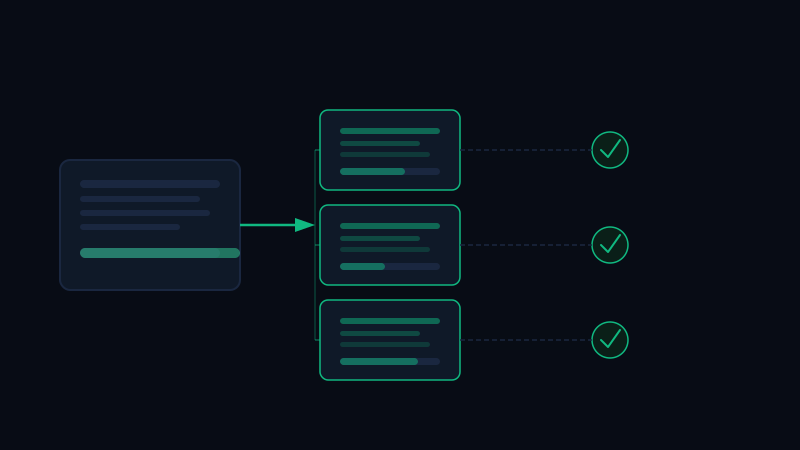
When a task exceeds its time budget in Hivemeld, the default behavior is not escalation. It is decomposition. The system analyzes the task that overran, identifies why it overran, and splits it into sub-tasks that are each scoped to fit within the budget.
This distinction matters enormously. Escalation says "we could not handle this, human take over." Decomposition says "this was bigger than the budget assumed, let us get the right structure for it." The outcome of escalation is a human doing the work. The outcome of decomposition is the work continuing at the right granularity, without a human in the loop.
The agent doing the splitting is not arbitrary. It is the same agent that was working on the task, or a dedicated decomposition agent that specializes in breaking down over-budget work. Either way, the split is informed: it uses what the executing agent learned about the task before it hit the budget limit to produce sub-tasks that are both accurate and appropriately scoped.
Why tasks overrun in the first place
Tasks overrun for three reasons, and the decomposition approach handles each differently.
The first is underestimation. The task was assigned a budget based on an assumption about its complexity, and that assumption was wrong. The actual work was larger than expected. This is the most common case and the clearest argument for decomposition: the right response to discovering a task is bigger than expected is to plan it properly, not to abandon it.
The second is dependency latency. The task is waiting on something external — an API response, a database query, a file that has not been generated yet. A timeout fires regardless of whether the wait was expected or not. Decomposition can recognize a wait state and structure the sub-tasks accordingly: the work that can proceed continues, and the work that depends on the pending thing waits until it is available rather than being treated as a failure.
The third is genuine ambiguity. The task hit a point where it needs a decision before it can continue, and it was not designed to make that decision autonomously. This is the case where human input is actually warranted — but it is a much smaller escalation than "the whole task failed." Decomposition isolates the decision point and surfaces it specifically, leaving everything else to continue.
How the split works
When the time budget trips, the agent pauses and runs a decomposition analysis. The analysis has three parts.
First: what work has been completed so far? This is preserved explicitly. If the task was 60% done when it overran, that 60% does not get thrown away — it is committed as a partial result and the sub-tasks pick up from there. Idempotent task design makes this cleaner, but even non-idempotent tasks can usually preserve partial progress with careful state management.
Second: what remains, and why is it taking longer than expected? This is the diagnostic step. Was the remaining work larger than the budget assumed? Is there a specific subtask that is computationally expensive? Is there a dependency that needs to resolve first? The answer to this question determines the split structure.
Third: how should the remaining work be divided? The goal is sub-tasks that are each independently executable, appropriately scoped, and clearly ordered by dependency. Each sub-task gets its own budget, which may be different from the original task's budget if the decomposition reveals that the work is inherently expensive. A sub-task that is expected to take twenty minutes gets a twenty-minute budget, not a ten-minute one.
The right budget for a task
Setting the initial budget correctly is part of the system. A budget that is too tight causes unnecessary decomposition — every task splits on the first attempt. A budget that is too generous means overruns are not caught in time to matter.
The right budget is a function of the task type and historical performance. The system builds a model of how long different types of tasks actually take, and uses that model to set initial budgets automatically. For novel task types, the initial budget is conservative — better to decompose once and learn than to let a runaway task go unchecked for hours. As the system accumulates history for a task type, the budget calibrates to the actual distribution.
This self-calibration is what separates a dynamic budget system from a static one. Static timeouts are set once and drift out of alignment as the workload changes. Dynamic budgets update as the evidence updates. A task type that gets faster as the agent learns the relevant patterns will have its budget tightened automatically. A task type that gets slower as complexity grows will have its budget expanded.
What escalation is actually for
None of this means escalation disappears. Some tasks genuinely need human judgment — not because they overran, but because they hit a decision point where the system cannot make the right call without more information from you.
The difference is that escalation in a decomposition-first system is reserved for these genuine judgment calls, not used as the catch-all for anything that went wrong. When you get an escalation notification, it means the system has exhausted its ability to proceed autonomously and needs something specific from you — not that a timer fired and the work is now your problem.
This makes escalations worth responding to. An inbox full of timeout alerts trains you to ignore them. An inbox where every alert represents a real decision point trains you to engage. The signal-to-noise ratio of your escalation queue is a direct measure of how well your system is handling the difference between "needs more time" and "needs a human."
Build tasks with budgets. Let over-budget work decompose. Reserve escalation for genuine decision points. That is a task system that gets more capable over time, rather than one that generates more alerts.
Ready to put AI agents to work? Get started with Hivemeld