
B2B Sales Pipeline Best Practices That Actually Hold Up
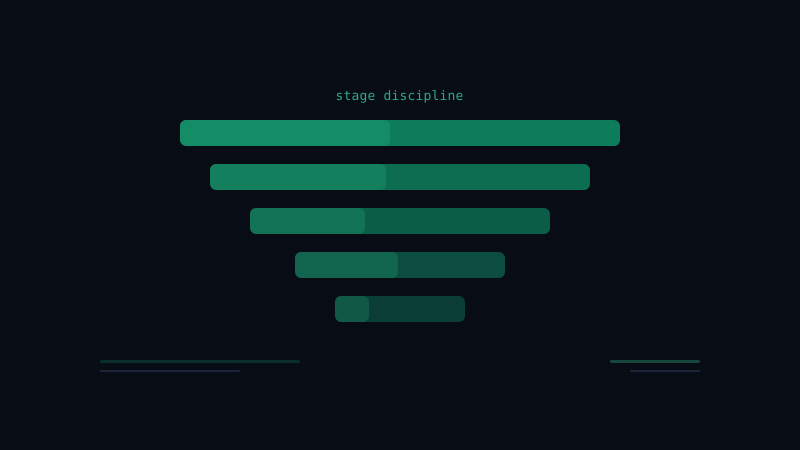
Pipeline health is the leading indicator of revenue health. If you can see your pipeline clearly — accurate stages, real close dates, honest probabilities — you can predict your quarter with confidence. Most companies can't.
Here are the practices that separate high-performing B2B sales teams from everyone else.
1. Define Stage Exit Criteria, Not Entry Criteria
Most pipelines use entry criteria: "A deal enters Discovery when we have a first meeting scheduled." The problem with entry criteria is that they don't tell you when to move forward.
Stage exit criteria force specificity: "A deal moves from Discovery to Evaluation when we have confirmed budget exists, identified the key decision maker, and received a request for a proposal or demo."
Exit criteria make pipeline reviews honest. Either the criteria are met or they're not. No more deals stuck in "Discovery" for six months because a rep is optimistic about a prospect who won't return calls.
2. Keep Your Pipeline Stages Minimal
The optimal number of pipeline stages for most B2B companies is 4-6. Common mistake: building a 12-stage pipeline that mirrors every micro-step in your ideal sales process.
Overly granular stages create three problems:
- Reps don't know which stage to use → inconsistent data
- Moving between stages feels like extra work → stages never get updated
- Pipeline reports become hard to interpret → reviews take longer
Recommended stages:
- Qualified (we believe there's a real opportunity)
- Discovery (active investigation of needs and fit)
- Evaluation (they're seriously evaluating us, possibly with competitors)
- Proposal (commercial terms shared, negotiation possible)
- Closed Won / Closed Lost
Simple enough that reps use it correctly. Specific enough to be useful.
3. Assign Pipeline Probability by Stage, Not by Gut
Most sales leaders let reps assign close probabilities based on feel. This produces wildly inconsistent forecasts — one rep calls everything 80%, another is chronically pessimistic.
Use historical win rates by stage as your baseline probability:
- Qualified: 10%
- Discovery: 25%
- Evaluation: 50%
- Proposal: 75%
Adjust based on deal-specific signals (engagement score, competitive situation, champion strength) but anchor to data. When reps know their probability is based on historical performance, not personal optimism, forecasts become defensible.
4. Ruthlessly Remove Stale Deals
Every quarter, audit your pipeline for deals that haven't had meaningful activity in 30+ days. For each one, you have three options:
- Actively pursue: Re-engage with a specific ask or deadline
- Mark as dormant: Remove from active pipeline, add to a nurture sequence
- Close as lost: Accept reality, capture the loss reason, move on
Stale deals are pipeline inflation. They make your numbers look good on paper while masking the real health of your business. A pipeline of 50 deals with 20 stale ones is actually a pipeline of 30.
The best sales managers run a "deal hygiene" review monthly. Any deal that can't answer "what happens next and when?" gets removed.
5. Track Velocity, Not Just Volume
Deal count and total pipeline value are lagging indicators. Pipeline velocity is the leading indicator:
Velocity = (Number of Deals × Win Rate × Average Deal Size) ÷ Average Sales Cycle Length
Track this metric monthly. If velocity is dropping, you'll see it before the quarter ends — giving you time to course-correct.
Velocity drops can be diagnosed:
- Fewer deals? Fix top-of-funnel or rep activity
- Win rate dropping? Fix discovery, demos, or competitive positioning
- Deal size shrinking? Review ICP and qualification criteria
- Sales cycle lengthening? Identify where deals are stalling and why
6. Require a "Next Step" on Every Open Deal
This is the single highest-leverage pipeline discipline: every open deal must have a specific, scheduled next step.
Not "follow up next week." Not "send proposal when ready." A specific action with a specific date:
- "Send pricing proposal by Thursday October 10"
- "Call with their CTO scheduled for Monday October 14 at 2pm"
- "Demo for evaluation committee on October 17"
If a deal can't answer this question, it's not a deal — it's a hope. Hopes don't forecast. Next steps do.
7. Use AI to Flag What Your Eyes Miss
Even disciplined pipeline managers miss things at scale. AI pipeline monitoring catches:
- Deals where email engagement has dropped 50% in the last 7 days
- Deals where close date has been pushed back 3+ times
- Deals where only one stakeholder has been engaged (single-threaded risk)
- Deals that are aging out of stage without movement
- Deals where the prospect's language suggests they're evaluating competitors
Human reviewers in a pipeline meeting look at stage and close date. AI looks at everything — and flags what deserves attention before the deal dies silently.
The Outcome: Predictable Revenue
Execute these practices consistently and you'll see three changes within 90 days:
- Forecast accuracy improves — you stop being surprised by your own quarter
- Deal velocity increases — fewer deals stall, more move to close
- Win rates improve — because you're working the right deals at the right time
A healthy pipeline isn't just a spreadsheet that looks good. It's the mechanism by which your sales team converts effort into predictable, scalable revenue.
Ready to put AI agents to work? Get started with Hivemeld