
Cleaning Your Funnel: Why Internal Accounts Are Ruining Your Metrics
The metric that felt right but was not
For the first few months of Hivemeld, our signup numbers looked reasonable. Not great, but reasonable — steady week-over-week growth, a conversion funnel that seemed to be working, activation rates that suggested users were finding value. We made product decisions based on those numbers.
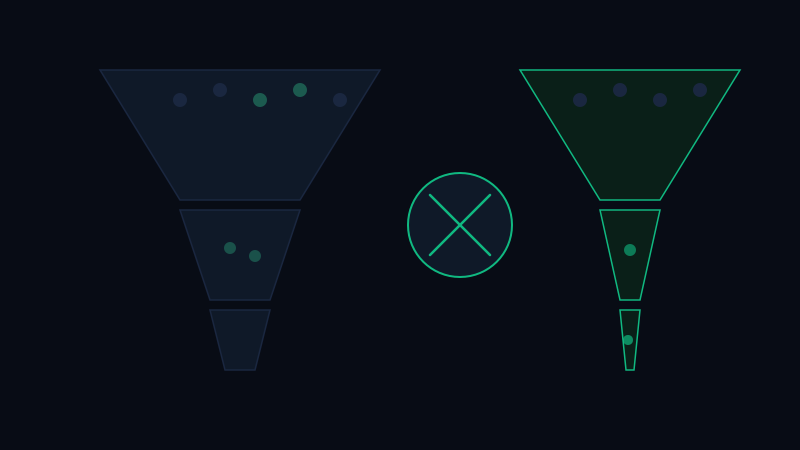
Then we cleaned the data and discovered that a significant fraction of what we had been calling "signups" were us. Our own team, testing the onboarding flow. Accounts created to reproduce bugs. Staging users that had made it into the production database through a configuration error. The numbers that felt reasonable were inflated by our own activity, and the real external signup count was lower than we had been telling ourselves.
This is not a unique problem. It is one of the most common data hygiene failures in early-stage SaaS, and it is embarrassing enough that most companies do not talk about it. We are talking about it because the cleanup is genuinely actionable, and because the real numbers, once you have them, are more useful than the inflated ones even when they are worse.
How internal accounts contaminate funnel data
The contamination happens in predictable ways.
The most obvious is direct team usage. Every founder and engineer who signs up for their own product using a real account is a user who never went through your actual acquisition funnel, who has no meaningful activation threshold to cross, and who will never churn because they work there. Including them in your signup cohorts makes your funnel look healthier than it is at the top and confuses your activation analysis because power-user behavior from employees gets averaged in with new-user behavior from actual new users.
The second source is test accounts. QA engineers creating accounts to test the onboarding flow, developers creating accounts to reproduce a bug, customer success creating an account to verify a fix. These accounts go through the funnel, contribute to your "signup" numbers, and then do things that real users do not do — triggering edge cases, resetting to initial states, running automated actions. Their behavior looks like user behavior but is not.
The third source is the one that bit us: configuration errors. A staging environment that shares a production database, or a development environment that points at production APIs, or a migration that carries over test data without filtering. These create accounts in your production user table that never came from a real signup flow at all.
The cleanup approach
Cleaning the funnel requires identifying which accounts to exclude and removing them from historical analysis without corrupting the historical record.
We used email domain as the primary filter: accounts with our company domain are internal by definition and get excluded from all funnel metrics. This catches the most obvious contamination — employee accounts — with no edge cases.
We also added an explicit is_internal flag to the user record, settable by admins, which lets us mark accounts that are not on our company domain but are clearly internal: accounts created by contractors, accounts used for demos, accounts we created to test customer-reported issues. The flag is logged with a reason and timestamp so there is an audit trail.
For the historical contamination — the test accounts and the staging-database-in-production incident — we identified accounts by creation pattern: accounts created in rapid succession from the same IP, accounts that triggered known QA test sequences, accounts with email addresses matching our test fixtures. These got flagged retrospectively and excluded from the historical funnel.
The key principle is that cleanup should never delete records. Deleting records destroys the ability to audit your own corrections. Instead, the exclusion flag is set and all metrics queries filter on it. The underlying records stay intact.
What the real numbers showed
After cleanup, our signup count dropped by about 30% from what we had been reporting internally. Our activation rate — users who complete the onboarding demo — looked better in percentage terms, because the denominator was now only real users, and real users activate at a higher rate than mixed real-and-internal cohorts. Our weekly active user count was lower in absolute terms but more stable week-over-week, because internal testing activity had been introducing noise.
The cleaned numbers told a clearer story: we had real users, they activated at a reasonable rate, but there were fewer of them than we thought. The honest baseline is a better foundation for growth decisions than the inflated one. You cannot fix a leaky funnel if you do not know where the leaks are, and you cannot find the leaks if you cannot see which water is real.
The instrumentation that prevents re-contamination
Cleaning historical data is a one-time effort. Preventing re-contamination is ongoing.
We now tag every account with its acquisition source at creation time: organic, paid, referral, or internal. Internal accounts get the flag set automatically based on email domain and can be set manually through the admin interface. Funnel dashboards filter on acquisition source by default, showing only organic and paid accounts, with internal available as a separate view.
We also separated the staging database from production entirely. This was overdue for other reasons — staging should never share infrastructure with production — but the data contamination was the forcing function that made us prioritize it.
The broader point is that your funnel metrics are only useful if they accurately represent your actual users. Early-stage products are unusually vulnerable to internal contamination because the team is actively using the product they are building and their usage patterns look like user usage patterns from the outside. The solution is explicit tracking of account provenance from day one — not a cleanup you run six months in when you notice something is off.
Tag your internal accounts. Filter your dashboards. Build the instrumentation early. The numbers are going to tell you things you do not want to hear. You want them to be accurate when they do.
Ready to put AI agents to work? Get started with Hivemeld