
Customer Health Scoring: A Guide That Survives Renewal Season
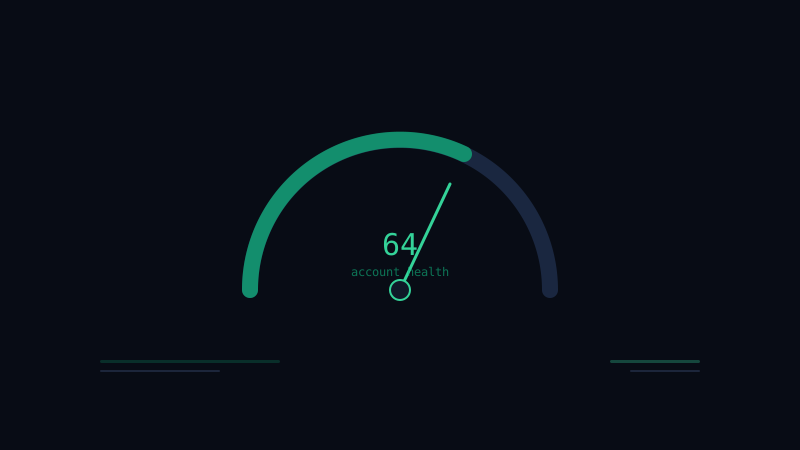
The cruelest thing about churn is how quiet it is. A customer rarely announces they're leaving — they just slowly stop engaging, until one day a renewal email goes unanswered and it's already too late.
Customer health scoring exists to make that silence loud. A good health score surfaces at-risk accounts months before the renewal date, while there's still time to act. Here's how to build one that works.
What a Health Score Actually Measures
A health score is a single number (often 0–100, or a simple red/yellow/green) that rolls up the signals predicting whether an account will renew and grow. The art is choosing signals that are leading, not lagging. By the time revenue drops, it's lagging. You want the signs that come first.
The strongest health signals fall into four buckets:
1. Product engagement
The clearest predictor of renewal is whether people actually use the thing.
- Are logins steady, rising, or falling?
- Is usage spreading across the team, or concentrated in one champion?
- Are they using the features tied to their original goals?
A drop in engagement is the earliest and loudest churn signal there is.
2. Relationship signals
Accounts renew through people, and people change.
- When did you last have a real conversation (not a support ticket)?
- Is your champion still there — or did they just leave for a new job?
- How many stakeholders do you actually know inside the account?
A single-threaded account where your one champion goes quiet is a renewal in danger, no matter how good the usage looks.
3. Support and sentiment
How an account feels shows up before it shows up in the numbers.
- Ticket volume and, more importantly, ticket tone
- Escalations and unresolved issues
- The language in emails — frustration, comparison-shopping, silence
4. Commercial signals
The business context around the account.
- Are they on an annual or month-to-month commitment?
- Have they expanded, or stayed flat since onboarding?
- Did they hit the outcome they bought the product for?
Turning Signals Into a Score
You don't need a data-science team to start. A workable first version:
- Pick 5–8 signals you can actually measure today
- Weight them by how strongly each predicts renewal (engagement usually weighs most)
- Roll them into a 0–100 score with clear thresholds (e.g. <50 = at risk)
- Review the scores against accounts that actually churned — and adjust the weights
This is where AI earns its place. Reading email tone, spotting a champion's departure from a signature change, and noticing a slow engagement decline are exactly the fuzzy, qualitative signals that rules-based scoring misses and language models catch.
What to Do When a Score Drops
A health score is only useful if it triggers action. Define plays for each state:
- Green → Yellow: a proactive check-in, not a fire drill. Often it's a single quiet champion — re-broaden the relationship.
- Yellow → Red: escalate. Get a senior CSM or exec involved, diagnose the root cause, and build a recovery plan with a clear owner and date.
- Red with a renewal approaching: this is all-hands. Loop in the account exec, revisit the original goals, and have a direct conversation about value.
The worst outcome isn't a red account — it's a red account nobody noticed until renewal week.
Common Mistakes
Too many signals. A 30-input model nobody understands is worse than a 6-input one the team trusts. Start simple.
Scoring without acting. A dashboard of red accounts that triggers no plays is just decoration.
Ignoring tone. Usage can look fine while sentiment quietly collapses. The qualitative signals matter.
Set-and-forget weights. Re-check your model against real churn every quarter and adjust.
The Bottom Line
Churn is rarely sudden — it's a series of quiet signals that nobody connected in time. A customer health score connects them, turns them into a number, and tells your CS team where to spend their attention while it still matters.
In Hivemeld CRM, health scoring blends product engagement, relationship signals, and email sentiment into one view, so at-risk accounts surface early — and your team gets to save renewals instead of mourning them.
Ready to put AI agents to work? Get started with Hivemeld