
Why We Put the Paywall After the Demo, Not Before
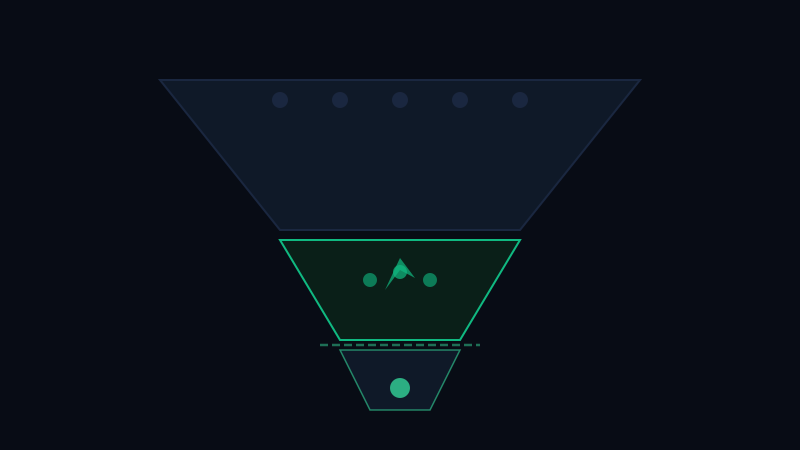
The standard paywall is in the wrong place
Walk through the signup flow of almost any B2B product and you hit the paywall before you have seen anything worth paying for. Name, email, company, and then a pricing page. Enter a card. Start a trial. Before you have touched the product, before you have understood what it does, before you have had a single moment of "oh, this is what I have been missing," you are being asked to make a financial commitment.
This sequencing is bad for buyers and, counterintuitively, bad for the product too. Someone who pays before the aha moment experiences the product as something they have invested in rather than something that impressed them. Every friction point becomes a reason to cancel rather than a reason to figure it out. The paywall ends up filtering for the people with the most patience rather than the people for whom the product is most valuable.
We made this mistake in Hivemeld's first version. The paywall came before the demo. Conversion was low, not because the product was bad, but because we were asking people to decide before they had the information to decide well.
The aha-moment-first principle
The aha moment for Hivemeld is specific: it is watching an agent complete a real task in your workspace — not a toy example, not a demo video, but actual work done by an agent, finishing while you watch — and understanding that this is not a chatbot. It is a team.
Before that moment, people are skeptical, reasonably so. The space is full of products that promise autonomous AI and deliver glorified autocomplete. The word "autonomous" has been so thoroughly overused that it no longer carries meaning without proof. The aha moment is the proof.
The principle says: put no friction between a new user and that proof. No paywall, no card form, no lengthy configuration wizard, no email verification step that introduces a day's delay. Get them to the moment that makes the product self-evident, then ask them to pay.
What the demo actually is
Onboarding is three steps. Name your company. Pick the team or role you want first. Then an agent deploys and immediately runs a real task, live, with the output appearing as it works.
The whole sequence takes a few minutes. At the end of it, the person has seen the product work. They did not read a description of how it works or watch a video of someone else using it. They saw it work, on something that resembles the kind of work they actually do.
That is when we show the paywall.
The timing is not arbitrary. We compared conversion for people who saw the paywall before the demo against after, and the gap was wide enough that going back is not a consideration. People who reach the paywall after the demo understand what they are paying for. That understanding is what converts.
Why this works beyond the conversion metric
There is a psychological dimension that matters more than the number.
Someone who sees a paywall before an aha moment is in a defensive posture. They are evaluating a claim — "this is worth paying for" — without evidence. Their job is to be skeptical, and the paywall stands between them and the information they need.
Someone who hits a paywall after an aha moment is in a completely different posture. They already know it works. The paywall is not asking them to bet on an unknown. It is asking them to formalise a relationship they have already decided they want. That is a much easier ask.
This is also why trials work better anchored to an experience than to a calendar. A fourteen-day trial that starts at signup is fourteen days of mostly uncertainty punctuated by moments of value. A trial that starts after you have seen the product do something real starts from established value and gives you time to find more of it.
The uncomfortable part: the demo has to be perfect
The demo-before-paywall approach requires something most teams resist building: a genuinely impressive, genuinely reliable first run.
A demo that fails — even once, even for a small fraction of people — is worse than a paywall before the demo, because now you have sold someone on a product that then broke in front of them. It has to work every time, with a task meaningful enough to be impressive and constrained enough to be reliable.
Getting this right took longer than we expected. The workspace has to initialize fast and in isolation. The agent has to handle the task deterministically, with no path where it gets confused and produces something embarrassing. The interface has to make clear what is happening and why it matters. And there has to be an escape hatch: when the first run does fail, the person needs somewhere to land that is not a dead end, because the agent they created still exists and the product still works.
All of that is hard. The conversion numbers make it worth the investment. An impressive first run that always works is an acquisition asset, and every person who watches it is a potential customer who already has the evidence they need.
A note on what the paywall says
One thing we got wrong for a while, separately from placement: the paywall itself described a single plan, because for a stretch that was all there was.
That was a mismatch with how the product is actually bought. A department head buys a team. An ops lead buys the system of record and may never deploy an agent. A COO buys several teams at once. One number on a page cannot address three different buyers, and a buyer who cannot find themselves on your pricing page assumes the product is not for them — which is a conversion problem dressed as a pricing problem.
The lesson generalises past us. The paywall is not just a gate; it is the first place a buyer checks whether you understand their situation. Put it after the proof, and make sure what it says matches who is reading it.
The broader principle
Paywall placement is a specific instance of a general rule: earn trust before asking for commitment.
Every ask you make of a new user — share your data, connect your tools, invite your team, enter your card — is a commitment. People have a limited budget of trust they will extend to a product they have not validated. Spend that budget before delivering value and you run out before they have a reason to refill it.
The right sequencing is always: deliver value first, then make the ask that lets you deliver more. The demo delivers value. The paywall is the ask. In that order it makes sense. In the opposite order it is a gamble.
Ready to put AI agents to work? Get started with Hivemeld