
The Goal-Directed AI Model: Why the CEO Agent Changes Everything
The problem with task-first thinking
Most people build AI workflows the same way they build automation: start with a task, find an agent to do it, wire it into a trigger. Summarize this. Draft that. Run this script on a schedule. The approach works for simple, self-contained operations — but it hits a ceiling fast. When the work is complex, when context matters, when the right next action depends on what happened in the last three steps, task-first systems break down. They do the task you specified, not the task you needed.
The goal-directed model flips the starting point. You do not begin with a task. You begin with an outcome — something your business actually cares about, stated at the level of what you want to be true, not what you want to happen. That shift sounds philosophical, but it has concrete consequences all the way down the stack.
What the CEO agent actually does
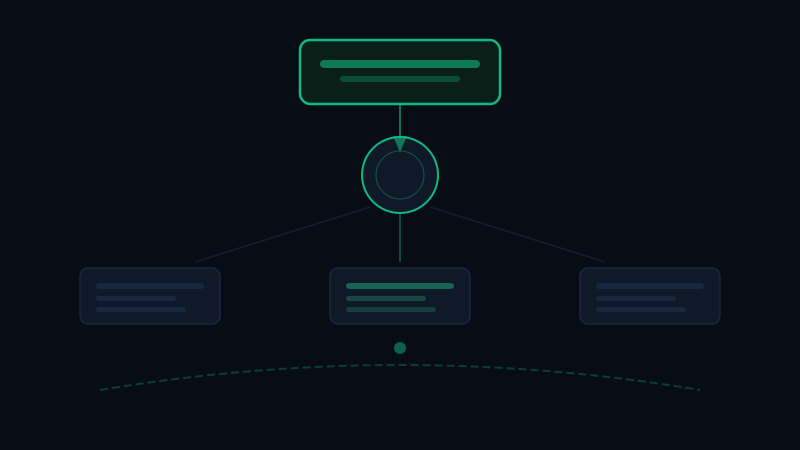
At the top of the Hivemeld model sits a CEO agent. Its job is not to execute work. Its job is to hold the primary goal and translate it into structure.
When you give the CEO agent a goal — "ship the new billing system before the end of the quarter" — it does not immediately spawn a dozen agents and start running. It reasons about the goal: what work does achieving it require, what is the right order to do that work, what decisions will need to be made along the way, and what does done actually look like. That reasoning produces a decomposition: a set of subgoals, each of which is a meaningful chunk of progress toward the primary outcome.
Subgoals are not tasks. A task is "write the Stripe webhook handler." A subgoal is "payment events are being captured and stored correctly." The subgoal defines what needs to be true. The tasks that achieve it get generated later, by agents that understand the subgoal and know what work it requires. This distinction is what keeps the system oriented toward outcomes even as individual pieces of work get delegated.
Subgoal decomposition at depth
For complex goals, the decomposition runs multiple levels deep. A primary goal breaks into subgoals. Each subgoal may break into sub-subgoals. The CEO agent handles the top level and delegates downward, with each level of the hierarchy responsible for understanding its piece of the goal and breaking it into the next level.
This mirrors how the best human organizations actually function. A VP of Engineering does not list every ticket that needs to be written. They define the outcomes their teams own — reliability, velocity, coverage — and their leads translate those into the work that achieves them. The CEO agent plays the VP role. The agents below it play the lead role. The tasks are what fall out at the bottom.
What makes this powerful is that the decomposition stays coupled to the goal. When something changes — a dependency fails, a design decision shifts, an external factor invalidates a subgoal — the system can re-decompose from the level where the change occurred rather than abandoning everything and starting over. The primary goal remains stable even when the path to it changes.
Dynamic agent teams
Once the CEO agent has decomposed the goal into subgoals, it assembles the teams that will execute them. This is where "dynamic" matters. The teams are not fixed configurations you set up in advance. They are assembled based on what the subgoal actually requires: which capabilities are needed, which tools are involved, how much parallelism is possible, and what the risk profile of the work looks like.
A subgoal that involves code changes, documentation, and a database migration gets a team with an engineering agent, a docs agent, and a data agent — each with the specific tools and permissions that their part of the work requires. A subgoal that is entirely research gets a single analyst agent with read access to the relevant sources. A subgoal with high risk of irreversible mistakes gets a smaller team with a tighter review loop.
The CEO agent is not the only one making these assembly decisions. Each level of the hierarchy can assemble the agents it needs for its portion of the work. What the CEO agent provides is the initial team for the top-level subgoals and the coordination protocol: how agents should hand work to each other, what constitutes a completed subgoal, and when to surface decisions up the hierarchy rather than making them autonomously.
The QA and deploy loop
Work flows down through decomposition and team assembly. What comes back up is results — and results go through a QA loop before they are committed or deployed.
Every meaningful output from an agent team passes through a verification step before it is treated as done. For code, that is the QA agent running tests and validation. For content, it is a review against the criteria the subgoal defined. For data changes, it is an integrity check. The specific gate depends on the type of work, but the principle is constant: no result moves forward without verification.
When the QA loop passes, the result is committed — merged, deployed, saved, published, depending on what the work required. When it fails, the failure is routed back to the team that produced the result, with the information needed to address it, and the loop runs again. The CEO agent sees the pass/fail signal for each subgoal and uses it to update its model of progress toward the primary goal.
This is how the system avoids the failure mode of goal-directed systems that optimize for the wrong thing. Without a QA loop, an agent team that is measured on "shipped code" will ship code that breaks tests. With the loop, the only way to move a subgoal from open to done is to pass the gate. The goal and the quality standard are enforced together.
Why the primary goal changes how the whole org operates
The most important effect of the goal-directed model is not any specific mechanism — it is the way it aligns everything underneath it.
When agents operate from a task list, they complete tasks. When they operate from a goal, they make decisions in light of that goal. An agent that is handed a task executes it and waits for the next one. An agent that understands it is working toward a specific outcome can reason about whether its work is actually moving toward that outcome, flag when something it discovers suggests the approach is wrong, and make judgment calls that keep the goal on track even when the specified path turns out not to be the right one.
This is the difference between a workforce that does what you say and a workforce that does what you mean. Task-first systems do what you say — they are faithful to the specification, even when the specification is wrong. Goal-first systems do what you mean — they stay oriented toward the outcome even when the specific tasks need to change.
Setting up the primary goal
In practice, this means the most important thing you do in Hivemeld is not configure the agents. It is write the primary goal. A poorly specified goal — vague outcome, unclear success criteria, no sense of constraints — produces a system that generates activity without producing results. A well-specified goal — concrete outcome, measurable criteria, explicit constraints — produces a system that makes good decisions at every level of the hierarchy.
The format that works: a one-sentence statement of what you want to be true when the goal is achieved, followed by two or three criteria that let you verify it without ambiguity. "The billing system is live" is not a goal. "The billing system is live in production, handling real payment events, with no failed webhook deliveries in the first 48 hours" is a goal. The CEO agent can reason from the second one. It cannot make useful decisions from the first.
Give the CEO agent a goal you would be satisfied to achieve, written with enough specificity that you could tell a new hire whether they had achieved it or not. That is the input that makes the rest of the system work.
Ready to put AI agents to work? Get started with Hivemeld