
Hivemeld CRM vs Salesforce: Which Fits a Modern Sales Team?
Salesforce is the most established CRM in the world. It's powerful, endlessly configurable, and runs a huge share of enterprise revenue. So why would a sales team look at anything else?
Because power and configurability come with a cost — in setup, in admin overhead, and in the data-entry burden that lands on reps. Hivemeld CRM takes a different starting point: a system of record that builds and maintains itself from your email, so the busywork that makes reps hate Salesforce largely disappears.
Here's an honest comparison to help you decide.
The Core Philosophical Difference
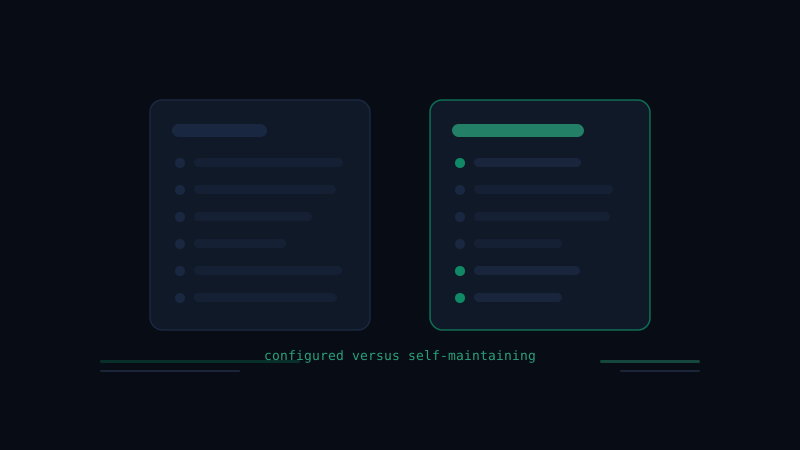
Salesforce is a system of record you configure. It's a blank, infinitely flexible platform. You (or an admin, or a consultant) shape it into your process, and reps keep it accurate by entering data.
Hivemeld CRM is a system of record that maintains itself. It connects to Gmail or Outlook, reads your sales conversations, and builds the pipeline automatically. Agents keep it current and correct it when the correspondence and the record disagree; reps step in on the calls that matter rather than typing in the ones that don't.
That difference shows up everywhere else.
Setup and Time to Value
Salesforce: A real Salesforce rollout is a project. Object models, page layouts, validation rules, and integrations often mean weeks to months — and frequently a paid admin or implementation partner. The flexibility is real, but so is the lift.
Hivemeld CRM: Connect an inbox, and your pipeline populates in minutes from existing email history. There's far less to configure because the system is opinionated about how AI-native sales should work out of the box.
If you need to be productive this week, that gap matters.
Data Entry and CRM Hygiene
This is the heart of it.
In Salesforce, the CRM is only as current as reps keep it. The well-known failure mode is empty fields, stale stages, and unlogged emails — which is why so many teams bolt on extra tools just to capture activity.
In Hivemeld CRM, activity capture is the default, not an add-on. Emails, meetings, and contacts sync automatically, deals advance from email context, and qualification fields fill in with citations. Every change an agent makes lands in an action log with the evidence attached, and a person gets pulled in for spend over a limit, an action type not yet cleared, a weak read, or an account you've flagged. The CRM trends toward current instead of toward stale.
AI: Built-In vs Bolted-On
Salesforce offers AI through Einstein, generally as a layered, higher-tier add-on on top of the core platform. It's capable, but it sits on top of data that reps still have to enter.
Hivemeld CRM is AI-native — scoring, coaching, qualification, and risk detection are core, working on data the system captured itself. There's no separate SKU to make the AI useful, because the AI is the point.
Power and Extensibility
Here's where Salesforce genuinely wins.
If you have deeply custom processes, a large RevOps team, an existing ecosystem of Salesforce apps, or complex enterprise requirements (intricate territory models, heavy CPQ, sprawling integrations), Salesforce's flexibility is hard to match. It can be molded into almost anything.
Hivemeld CRM is opinionated by design. It's extensible via API and covers the modern B2B sales motion well, but it's not trying to be an infinitely configurable platform. Two specifics worth knowing before you evaluate: migration from Salesforce is a CSV import rather than a live two-way sync, and single sign-on isn't available today. For some organisations either of those is disqualifying, and that's a fair reason to stay where you are.
Cost — Beyond the Sticker Price
We're not going to put a year-one total next to Salesforce's name. Every comparison table that does it, including ones we have published before, builds the number out of list prices that change and an admin salary that may or may not be incremental. Check Salesforce's own pricing page and your own quote.
What's structurally true is this. Salesforce's real cost includes seats, higher tiers for the features most teams want, add-ons, and often admin or consultant time to keep it running. Hivemeld CRM is per-seat with the AI in the core product and no implementation project, so the hours line is close to zero. Whether the total lands lower for you depends on how much of Salesforce you were actually going to use.
So Which Should You Choose?
Choose Salesforce if: you're a large enterprise with deeply custom processes, a dedicated admin or RevOps function, heavy CPQ or territory complexity, and an existing investment in the Salesforce ecosystem.
Choose Hivemeld CRM if: you're a sales team that wants to be selling this week, you're tired of reps hating CRM data entry, you want agents maintaining the record rather than an AI add-on commenting on it, and your process is a recognizable modern B2B motion rather than something bespoke.
The Bottom Line
This isn't a case of one CRM being objectively better. Salesforce is the right answer for organizations that need maximum configurability and have the team to wield it. Hivemeld CRM is the right answer for teams who want their CRM to maintain itself and the AI to work out of the box, without an implementation project.
If your reps spend more time feeding the CRM than selling, that's the signal worth paying attention to. Connect an inbox and watch your pipeline build itself.
Ready to put AI agents to work? Get started with Hivemeld