
Inside the QA Agent: How Hivemeld Gates Every PR
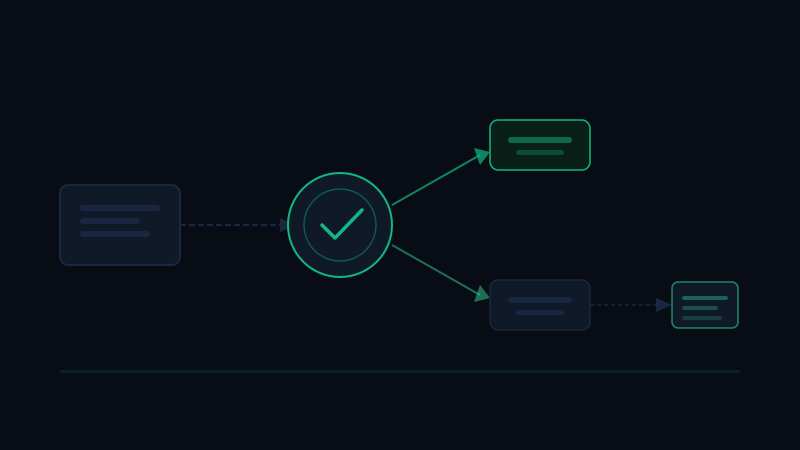
Why a dedicated QA agent beats shared CI
Most teams treat quality gates as a CI job: a pipeline that runs, turns red, and waits for someone to notice. The red state is information, but it is not action. Someone still has to look at the failure, interpret it, file a ticket, assign it, and route it back to whoever touched the code. That chain burns ten minutes of coordination for every broken build, and in a fast-moving codebase broken builds are constant.
The QA agent is different. It does not just run tests — it takes responsibility for the outcome. When a PR comes in, the agent owns the full cycle from checkout to verdict, including the follow-up work if the verdict is rejection. The human reviewing the PR gets a pass or a rejection with a task already filed. The loop closes without a meeting.
What happens when a PR lands
The moment a pull request opens, the QA agent picks it up from the task queue. The first thing it does is not run anything — it reads. It pulls the PR description, the diff, and the test file list, and it forms a plan: which test suites are relevant to this change, which are not, and whether the change touches anything that needs a full-suite run versus a scoped one.
That planning step matters more than it sounds. Running every test on every PR is the naive approach, and it is the approach that slows you down until developers start skipping tests locally to compensate. The QA agent scopes the run to what is actually at risk, which keeps wall time predictable and keeps developers in the habit of writing tests that the system will actually run.
Clean clone, every time
After forming the plan, the agent checks out a clean copy of the branch. Not a dirty workspace, not a cached checkout — a fresh clone into an isolated directory. This is non-negotiable, and it is where a lot of ad-hoc CI setups fail.
Dirty workspaces accumulate state that makes tests pass when they should fail. A file that should have been deleted but was not. A build artifact from a previous run that masks a compilation error. A database migration that ran manually during development and never got captured in a migration file. A clean clone is the only way to know what the code actually does, rather than what it does in the specific environment where it was written.
The agent also pins the dependency install to the same resolver and lockfile that CI uses. Dependency drift — where a developer's local environment has slightly different package versions than production — is one of the most reliable sources of "it works on my machine" failures. The QA agent does not guess at the right environment. It uses the documented one.
Scoped test run with full output capture
With a clean environment ready, the agent runs the scoped test suite and captures everything: stdout, stderr, exit codes, test-by-test pass/fail status, timing, and any output written to files. It does not just wait for a final exit code — it streams the output so that the failure context is preserved in full, not reduced to "tests failed."
This matters at review time. A rejection task that says "the auth suite failed" is almost useless. A rejection task that says "three tests in test_token_refresh failed with a JWT expiry mismatch, full output below" is something a developer can act on in five minutes. The difference is whether the agent captured the right information or just the final verdict.
Dependency validation before the run
One step that runs before the tests themselves: a dependency audit. The agent checks that the packages installed in the clean clone match what the lockfile specifies, and it compares the lockfile to what CI will see when the PR merges. If a developer has introduced a new dependency without updating the lockfile, or if the lockfile has a conflict that will fail silently on some platforms, the agent catches it here rather than letting it pass to a later stage where it is harder to diagnose.
This is especially important for multi-environment deployments. A package that installs cleanly on macOS but fails on the Linux container that CI runs in is a category of bug that almost never gets caught locally. The QA agent runs on the same platform as CI, with the same toolchain, which means it catches those failures before they become a production incident.
Filing rejection tasks automatically
When tests fail, the agent does not just mark the PR as rejected and stop. It files a task in the workspace backlog — structured, assigned to the PR author, linked to the PR, and containing the failure output. The task describes what failed, where it failed, and what information the developer needs to reproduce it.
This is where the QA agent earns its keep as an agent rather than a script. A script marks the check as failed. An agent understands that the purpose of marking a check as failed is to get the problem fixed, and it takes the steps that move toward that outcome. The developer gets a notification, opens the task, and has everything they need without asking the QA agent or the reviewer a single question.
The task also includes a link back to the specific test run, so the developer can see the full output rather than the agent's summary of it. Summaries are useful for routing. The full output is what you need to actually fix something.
What the reviewer sees
By the time a human reviewer opens the PR, the QA agent has already done the work. There is a clear status: pass or reject. If it passed, the reviewer can focus on the code quality questions that a machine cannot answer — the design decisions, the naming, the edge cases that are not covered by tests yet. If it rejected, there is a task already filed and the reviewer does not need to do anything except note in their review that the failing tests need to be addressed first.
This shift matters more than it sounds. Reviewers who have to run tests themselves, or who have to write out failure explanations in review comments, are doing work that is one step removed from the judgment they are actually there to provide. Offloading that work to the QA agent means your best reviewers spend more time on the hard questions.
The gate is only as good as the tests
One thing the QA agent cannot do is fix bad tests. A test suite full of shallow happy-path checks will pass on bad code. A test suite with no integration tests will miss entire categories of failures. The agent faithfully runs what is there — it does not invent coverage that does not exist.
This is intentional. The QA gate is a forcing function for the team to write tests that actually catch things, because those are the tests the gate runs on every PR. If developers learn that the gate does not catch a certain class of failure, the natural response is to write tests that do — not to disable the gate. The gate's power comes from its consistency, and its consistency depends on being honest about what it tests and what it does not.
Why this architecture beats a smarter CI
You might ask why this is better than investing in a smarter CI pipeline — one that also scopes runs, also captures full output, also files tickets. The answer is that agents accumulate context across runs in a way that pipelines do not.
The QA agent notices when the same test has been flaky for three weeks. It notices when a particular developer's PRs consistently fail on a specific suite. It can surface patterns that would require a dedicated observability layer in a CI system. Over time, the agent becomes a genuine diagnostic resource rather than a pass/fail gate — and that accumulated context is what turns quality enforcement from a speed bump into a reliability investment.
Set it up once, point it at your repo, and let it own the gate. The PRs that pass will be cleaner, the ones that fail will have better diagnostics, and your reviewers will spend their time on the questions only they can answer.
Ready to put AI agents to work? Get started with Hivemeld