
From Insight to Action: Agents That Fix the Record Themselves
An insight that ends with "you should probably update that" isn't automation. It's a to-do list with better branding. The interesting question was never whether AI can spot a stale close date. It's whether anything happens afterwards.
The problem with insights that stop at insight
The first generation of AI in CRM was a commentary track. A panel on the side of the deal telling you the close date looked stale, the stage seemed behind, the contact record was missing a title. Useful, in the way a passenger reading road signs aloud is useful.
But every one of those observations still ended in manual work. You read the insight, agreed with it, opened the record, found the field, made the edit. Multiply that by forty deals and the insights start feeling like homework. Plenty of reps just stopped reading them, which is a rational response to a system that notices problems and hands them back to you.
The gap was never intelligence. It was the last step.
The obvious fix is to have the system make the change and ask you first. We built that, shipped it, and watched what happened — which is the more interesting part of this story.
What per-change approval taught us
Propose-and-approve works beautifully in a demo and degrades predictably in production.
The first week, reps read every diff. Close date June 30 to August 15, with the sentence from the buyer that justified it. Stage Evaluation to Negotiation, with the thread. Title blank to VP of Operations, from a signature. Genuinely good, and the approval took two seconds.
By week three the queue had forty items in it and the reps were clearing it in one gesture. Not because they were careless, but because the system was asking them to adjudicate things nobody would ever adjudicate. Does a contact's job title, lifted verbatim from their own email signature, warrant a human decision? If you ask that question forty times a week, you have built a rubber stamp and you've trained your team to use it.
That's the failure mode of approve-everything: the gate stops being a gate. Worse, it hides the cases that genuinely needed a person, because they arrive in the same undifferentiated pile as the title changes.
What the agents do now
Agents read your email and the full context of each deal, the way they always have. The difference is what happens next: for the ordinary cases, the change is simply made.
- Advance a stage. The buyer confirmed a contract review call and looped in procurement. The deal moves from Evaluation to Negotiation, and the log cites the thread that justified it.
- Fix a stale close date. The close date says June 30. The buyer wrote "let's pick this back up after our fiscal year closes in August." The date moves, with the sentence attached.
- Fill missing fields. A contact signs off with a new title, or a company's email footer reveals a headquarters change. The field fills from what the correspondence says.
Each change is specific, sourced, and small. Not "this deal needs attention." This field, this old value, this new value, this evidence.
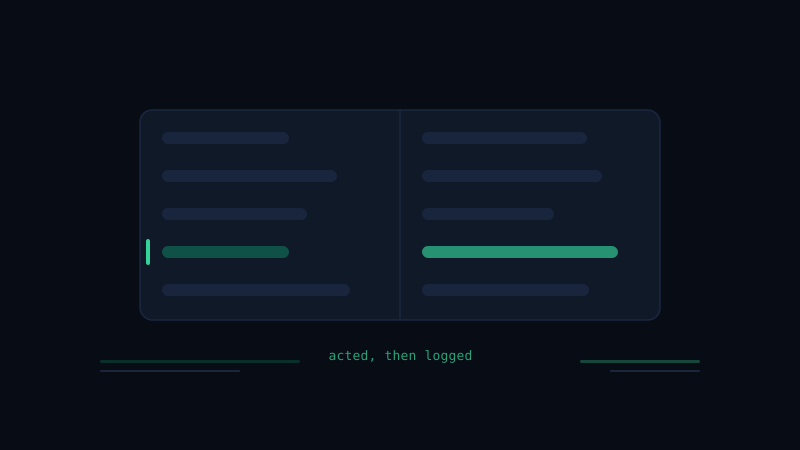
And every one of them is a diff you can read after the fact, which turns out to be what reps actually wanted. Not the right to veto a title change — the ability to see what moved on their deals this morning.
The four gates
Automation-first does not mean unsupervised. It means the default is action, and a short, explicit list of conditions routes a decision to a person instead:
Spend over a limit. Anything with a cost attached, above a threshold you set. An agent that can send mail can spend money; that one gets a ceiling, not a vibe.
A new kind of action. The first time an agent wants to do something outside what it has been cleared for, a human clears it. Clearing it once is a configuration change, not a per-instance approval, so the queue doesn't regrow.
Low confidence. When the agent's read of the evidence is weak — two plausible interpretations of an ambiguous sentence, a signal that contradicts another — it stops and asks. This is the gate that earns the others their credibility, and it's the one worth tuning hardest.
Flagged accounts. The strategic logo, the renewal sitting in legal, the customer who escalated last quarter. You name them, and nothing happens on them unattended.
The useful property of this list is that it is short enough to read and specific enough to argue about. "Use good judgment" is not a policy. "No action over $500, nothing on these twelve accounts" is.
Guardrails that aren't policies we hope the model follows
Two constraints keep this trustworthy rather than merely convenient.
Every change carries a full audit trail. The log records what changed, what the prior value was, what evidence supported it, which agent did it, and whether a human was involved. Six months from now, when someone asks why a close date moved, the answer is on the record instead of in someone's fading memory. Managers get a pipeline whose history explains itself.
Agents only touch a whitelisted set of fields. Stages, dates, and standard contact and company fields are in bounds. Everything outside that list is out of reach. An agent can't rewrite your notes, restructure your pipeline, or overwrite a judgment call hiding in a custom field. The boundary isn't a policy we hope the model follows. It's a wall the system can't cross.
That second point matters more than it might sound. The failure everyone rightly fears with AI writing to a CRM isn't a wrong close date. It's an unbounded system making confident edits in places nobody's watching. A whitelist plus a readable log means the blast radius of any mistake is one field, visibly, and reverting it takes a click.
Why not keep the approval step everywhere
Because trust in a CRM doesn't come from being asked. It comes from the record being right and the history being legible.
A rep who has to approve forty field changes a week does not trust the system more. They trust it less, because the queue is evidence that the system can't be left alone. A rep who opens the deal, sees three changes made overnight with the quotes that drove them, and finds one of them wrong — then reverts it in a click — has learned something real about how reliable the thing is.
There's a subtler benefit people expect approval to deliver, which is staying informed. That's worth keeping, and it doesn't require a gate. A morning digest of what changed on your deals does the same job in thirty seconds without pretending each line was a decision.
Data entry was never the valuable part of a rep's job. Judgment was. The split that works gives each side the work it's actually good at: the agents read everything, remember everything, and keep the record true; you spend your attention on the four cases that got routed to you and on the conversations the agents can't have.
Where this goes
This is the shape of everything we're building next. Not AI that dashboards you, not AI that acts behind your back, and not AI that makes you click forty times a week. Agents that do the work inside limits you wrote down, and a log that tells you exactly what happened while you were on a call.
A CRM that keeps itself current from your email was always the goal. The last step is the one that makes it true.
Ready to put AI agents to work? Get started with Hivemeld