
Stalled-Deal Detection: Finding Out on Day Two, Not Day Twelve
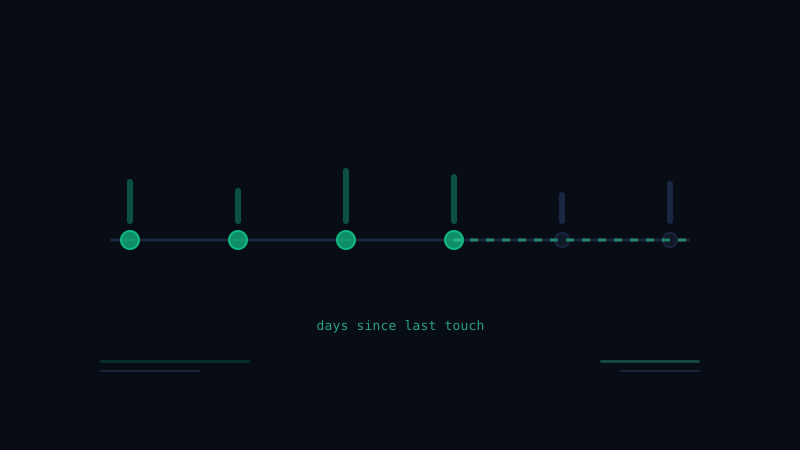
Deals rarely die with a rejection email. They die quietly. The champion stops replying, the next step never gets scheduled, and by the time anyone notices, the budget has moved and the moment has passed.
Ask a rep about their lost deals and you'll hear about the ones that blew up. The competitor who undercut them, the security review that went sideways. But look at a full quarter of closed-lost, and a bigger pattern shows up. Most of those deals didn't lose to anything. They just stopped. Silence is the leading cause of death in a B2B pipeline, and it's the one failure mode almost no team monitors for.
What "Stalled" Actually Means
A stalled deal is not just an old deal. Age is the lazy definition, and it produces bad lists. A 90-day-old enterprise deal moving steadily through procurement is healthy. A 20-day-old mid-market deal with no reply in a week is on fire.
A better definition has three parts:
- No meaningful activity. Not just any touch. A rep sending a fourth "just bumping this" email is activity, but it isn't progress. Meaningful means a reply from the buyer, a meeting held, a document opened, a stage advanced.
- Within a window relative to stage. Early-stage deals breathe slower. A week of quiet in discovery might be normal. A week of quiet during contract review is a flare going up. The threshold should tighten as the deal matures.
- Relative to the deal's own velocity. A deal that had three touchpoints a week and suddenly has none is telling you something, even if the absolute gap is still short. The change in rhythm is the signal.
Get this definition right and "stalled" becomes a precise, actionable category. Get it wrong and it's just a list of deals that annoy your reps.
Why Reps Notice Too Late
Nobody is better positioned to feel a deal going cold than the rep working it. So why does it keep happening?
Attention doesn't scale. A rep juggling 40 open deals is actively thinking about maybe eight of them, usually the biggest and the closest to signature. The mid-sized deal in stage three doesn't cross their mind until something forces it to.
Silence doesn't generate events. Your inbox tells you when something happens. It says nothing when something stops happening. There's no notification for "you haven't heard from this buyer in nine days." The absence of signal is itself the signal, and humans are bad at perceiving absence.
Optimism fills the gap. When a rep does notice quiet, the story writes itself. They're busy. It's end of quarter on their side. Legal has it. Sometimes that's true. Often it's the deal dying politely, and every day of assumed goodwill is a day the window closes further.
Why Pipeline Reviews Catch It Too Late
The traditional answer to all of this is the weekly pipeline review. It's a real safety net, but it has holes exactly where stalled deals fall through.
The cadence is too slow. A weekly review means a deal can sit silent for up to six days before anyone even has the chance to notice. Add a week of "let's see if they respond" and you're two weeks into a cooling deal before action happens.
Reviews run on the rep's narrative. The manager sees what the rep presents. A rep who hasn't clocked the stall reports the deal as fine, and the review confirms the blind spot instead of catching it.
Coverage is shallow by necessity. In a 45-minute review, the team talks through the big deals and the committed deals. The unremarkable middle of the pipeline, where most stalls happen, gets a glance at best.
Pipeline reviews are good at strategy. They are structurally bad at surveillance.
What Automated Detection Changes
Stalled-deal detection inverts the problem. Instead of humans scanning for silence, the system tracks every deal's activity continuously and flags the ones that cross their threshold.
Done well, it works like this. Every morning, each rep sees a short list. Not their whole pipeline, just the deals that went quiet, ranked by size and stage. Each flag carries context. Days since the last meaningful touch, what that touch was, who went dark, and what the agreed next step was supposed to be.
That context is the difference between a nag and a tool. "Deal stalled" creates guilt. "No reply from your champion in 11 days, the last touch was the pricing call, and the proposal was never opened" creates a next move.
What to Do With a Flagged Deal
Detection is half the job. The response is the other half, and the worst response is another check-in email. A few patterns that consistently work better:
- Change the channel. If email went quiet, call. If the champion went quiet, go to the second contact you've hopefully been building.
- Add value instead of asking for status. Send something the buyer's internal case needs. A relevant proof point, an answer to an objection raised on the last call.
- Name it honestly. "It seems like priorities may have shifted on your side" gets more truthful replies than a fifth bump. A fast no beats a slow one, because it frees the rep's attention for deals that are alive.
- Requalify before reinvesting. Some stalls are diagnoses. If there's no champion, no timeline, and no next step, the flag isn't telling you to push harder. It's telling you what the deal is.
Where Hivemeld Fits
This is exactly the kind of vigilance a CRM should provide on its own, which is why stalled-deal detection ships as a built-in watcher in Hivemeld. Because Hivemeld CRM builds your pipeline from Gmail and Outlook, it already sees the actual conversation, so "no meaningful activity" is measured against real email threads and meetings, not against whether a rep remembered to log a call. When a deal crosses its quiet threshold, the alert lands in Slack, email, in-app, or browser push with the context to act, and dedup and daily caps keep the signal worth trusting.
Silence will always be part of selling. Buyers get busy, priorities wobble, deals breathe. The difference between teams that lose deals to silence and teams that don't is simply who notices first. Increasingly, that job belongs to the CRM.
Ready to put AI agents to work? Get started with Hivemeld