
The Last Organizational Structure
Every era of work has had its own shape
The factory floor produced the hierarchy. Everyone had a role, a manager, and a chain of command that ran from the floor to the executive suite. It was efficient for what it needed to be efficient at: coordinating large numbers of people doing predictable, repeatable tasks in the same physical space.
The knowledge economy softened it. Matrix organizations, cross-functional teams, flat structures — each was an attempt to make large companies move more like small ones, to get the creativity and speed of a startup while keeping the scale of a corporation. None of them fully solved it. They mostly just made the hierarchy harder to see.
The question now is whether the next shift is another incremental adjustment or something that changes the underlying structure entirely. The evidence suggests the latter.
The headcount equation is breaking
For most of the last century, growth meant headcount. If you wanted to do more, you hired more. The ratio between output and people was roughly fixed by the tools available. You could improve it at the margins — better software, better processes — but the fundamental constraint was how many capable people you could hire, onboard, and coordinate.
That equation is breaking. Not gradually, at the margins, but structurally. A small team running AI agents can now produce output that would have required a much larger organization five years ago. Not because the people are working harder, but because the work that used to require a person — research, drafting, analysis, coordination, execution across dozens of tasks — can now be done by an agent running continuously, without onboarding time, without coordination overhead, without the thousand small frictions that make human teams expensive to scale.
This is not a productivity improvement. It is a change in what determines the ceiling.
What gets replaced first — and what doesn't
The roles that disappear first are not the lowest-skill ones. They are the highest-volume, most-standardized ones — the work that was once considered skilled but has become legible enough that a well-specified agent can do it reliably. Content production. Research synthesis. Data analysis. Code review. Customer triage. These were the bread-and-butter of large knowledge-work teams, and they are the first to be absorbed.
What does not disappear is judgment. The decisions that depend on context that cannot be fully specified, on values that cannot be fully encoded, on relationships that require trust built over time — those remain human work. Not because AI cannot reason, but because the accountability for those decisions needs to rest somewhere, and that somewhere is still a person.
The org structure that emerges from this is not a hierarchy with AI added. It is something closer to a very small team of decision-makers surrounded by an AI workforce that handles the execution. The team's job changes: less production, more direction-setting, quality judgment, and the relationship work that cannot be delegated.
The founder's role in an AI-first company
For founders, the implications are more personal than structural. The traditional model of company-building involves assembling a team, dividing work, and spending most of your time managing coordination rather than doing the work itself. It is a model that rewards delegation skill almost as much as domain skill.
An AI-first company inverts some of this. The leverage is not in finding great people and getting out of their way. It is in writing precise role definitions, building feedback loops that catch agent errors before they compound, and making the judgment calls that determine whether the direction is right. The founder who builds this well ends up closer to the work than a traditional CEO — not because they are doing the execution, but because the execution is transparent and continuous in a way that human teams rarely achieve.
The coordination overhead that consumed so much of a founder's time — the check-ins, the status updates, the managing of unclear ownership — collapses. What replaces it is a different kind of attention: monitoring output quality, adjusting direction, and deciding when a piece of work needs a human judgment call rather than another agent iteration.
The companies that won't adapt
The failure mode is not ignorance. Most organizations know that AI is changing things. The failure mode is treating it as a tooling upgrade rather than a structural shift — adding AI tools to the existing organization and expecting the benefit to show up in productivity metrics while leaving the underlying structure unchanged.
It will show up in productivity metrics. But the companies that treat it as a tooling upgrade will find themselves with a productivity advantage that is competed away within a few years, because the same tools are available to everyone. The durable advantage comes from rebuilding the structure around the new constraint set — from designing organizations that are optimized for human judgment at the top and AI execution everywhere else, rather than organizations designed for human execution with AI assistance sprinkled in.
That is a harder change. It means rethinking headcount plans, reporting structures, how performance is measured, and what a senior role actually means when the execution layer is no longer human. Most established companies will not make that change willingly. They will make it when the competitive pressure from organizations that already made it becomes impossible to ignore.
The shape of what comes next
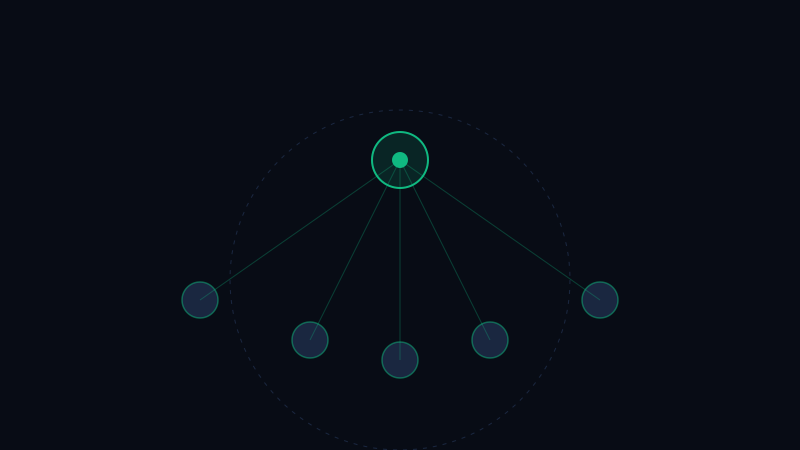
The org chart of an AI-first company is not a pyramid. It is closer to a hub and spokes, with a small core of humans who set direction and make judgment calls, surrounded by an agent workforce that handles execution across every function. The spokes can extend as far as needed — more agents, more coverage, more output — without a corresponding increase in the core.
This does not mean small teams replace large ones everywhere. There are domains where human collaboration, creativity, and trust are irreplaceable, and those domains will continue to support large human teams. But the default for scaling — add headcount — will no longer be the default. The question will be: which parts of this scale with agents, and which parts require people? And the answer, for most functions, will increasingly favor agents.
The last organizational structure is not the hierarchy or the matrix or the flat startup. It is the one being built right now, by companies that are taking seriously what it means to have AI as part of the team rather than as a tool the team uses. Whether you are building one of those companies is one of the more important questions you can ask yourself in the next few years.
Ready to put AI agents to work? Get started with Hivemeld